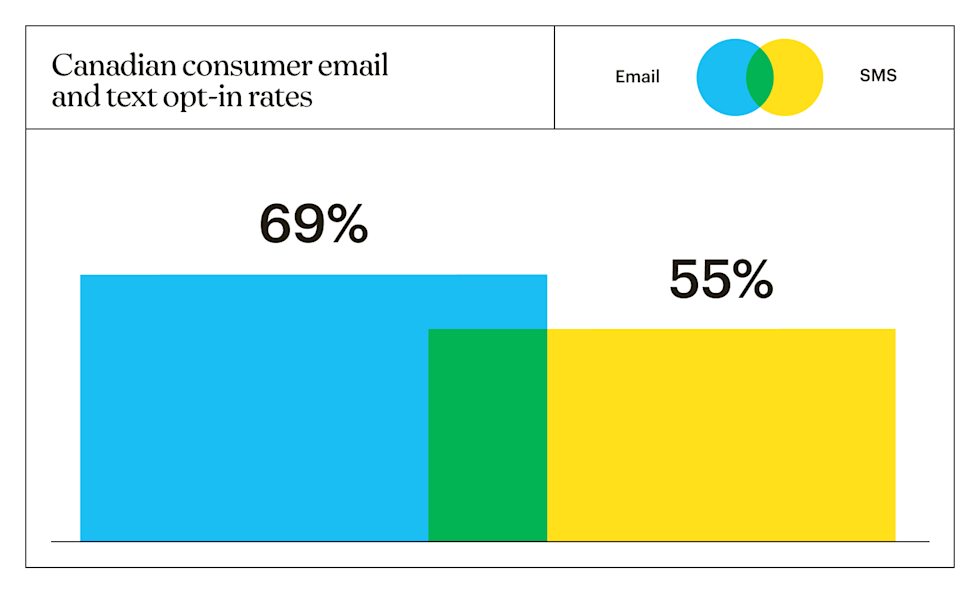
Canada leads in subscriber engagement. It also leads in sensitivity to volume. According to The Art of the Opt-In, 2026 research from Intuit Mailchimp and Ascend2, 69% of Canadian consumers have opted into email communications — tying with the United Kingdom for the highest rate globally and exceeding the United States. More than half (55%) have opted into SMS.
Source: Intuit Mailchimp and Ascend2, The Art of the Opt-In, February 2026
At the same time:
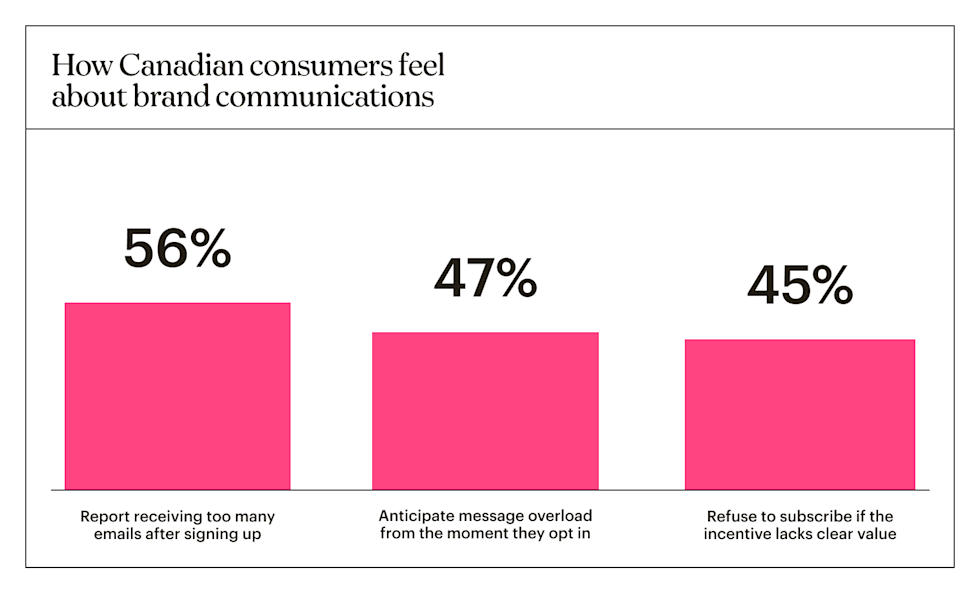
- 56% report receiving too many emails after signing up (the highest level among countries surveyed).
- 47% anticipate message overload from the moment they opt in.
- 45% refuse to subscribe if the incentive lacks clear value.
Canadian consumers are willing to engage, but access is earned through value and sustained through restraint.
Canadian subscribers willingly share data when it’s worth their while
Canadian consumers approach opt-in as a transaction. They view their contact information as an asset and expect a meaningful exchange.
- 59% cite discounts or promotional codes as their primary motivator for sharing information — a global high.
- 88% are comfortable with a two-step opt-in process.
- Email adoption matches the highest levels seen across regions.
These behaviours reflect a digitally sophisticated audience shaped by strong privacy norms and regulatory frameworks such as CASL. Canadians understand the mechanics of data exchange, and they expect transparency, clarity, and proportionality.
When communication volume exceeds perceived value, dissatisfaction rises quickly.
The combination of high opt-in rates and high message overload suggests a defining market characteristic: enthusiasm tempered by vigilance.
Canadian marketers may be overly cautious about data
Canadian marketers are especially attuned to data collection.
- 36% cite “how much information to collect” as a major concern — the highest across regions.
- 36% say completing sign-ups is their top challenge.
- 40% believe improved targeting or timing would strengthen performance.
- 28% use popups to capture subscriber information.
Caution around data is understandable in a tightly regulated environment. However, that caution isn’t necessarily visible to consumers at the moment of sign-up.
When consumers demand clear value and declared frequency, debates about form length or field count are irrelevant to them. What matters to them is the clarity of the offer and the credibility of the promise.
The opportunity lies in turning regulatory awareness into a competitive advantage.
Canadian brands are delivering more volume than value
Canada’s opt-in challenge centers on alignment.
Consumers respond strongly to incentives and willingly subscribe when the value exchange is compelling. Their expectations around frequency and relevance remain equally strong.
But when 56% report receiving too many emails after opting in, the consequences can extend beyond mere annoyance. They can affect retention, engagement, and long-term subscriber value.
In this market, early communication sets the tone for the entire relationship. Too many irrelevant messages create friction that accumulates over time. In sum, clear messaging strengthens trust, but inconsistent delivery weakens it.
Next steps for Canadian marketers
Source: Intuit Mailchimp and Ascend2, The Art of the Opt-In, February 2026
Canada offers a powerful growth advantage: Consumers are prepared to engage at scale. But transforming that engagement into loyalty requires intentional design.
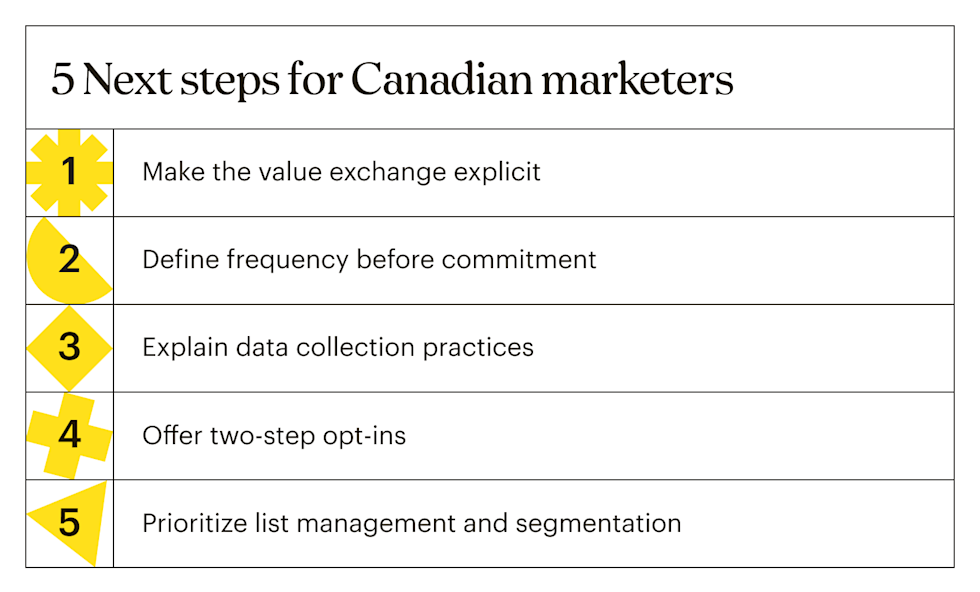
1. Make the value exchange explicit
Given that 59% of consumers prioritize discounts and promotional incentives, position the benefits sharing contact information clearly and prominently.
2. Define frequency before commitment
Address overload expectations by stating how often subscribers will hear from you.
3. Explain data collection practices
Show how data will be used and offer accessible preference controls. Transparency functions as a conversion driver in this market.
4. Offer two-step opt-ins
With 88% of consumers comfortable confirming their subscription, the second step provides a moment to reinforce clarity and tone.
5. Prioritize list management and segmentation
In a market highly attuned to volume, behavioral targeting and preference management support retention and lifetime value.
The future of Canadian opt-in strategies
Canada combines high engagement with high expectations. This dynamic creates both pressure and opportunity.
Strong opt-in rates demonstrate consumer openness, while elevated dissatisfaction with message volume highlights the need for thoughtful execution.
Brands that manage the value exchange carefully — from incentive through onboarding — will extend subscriber lifespans and deepen engagement. Those that pursue short-term list growth could accelerate churn.
The future of subscriber growth in Canada will favor brands that use restraint.