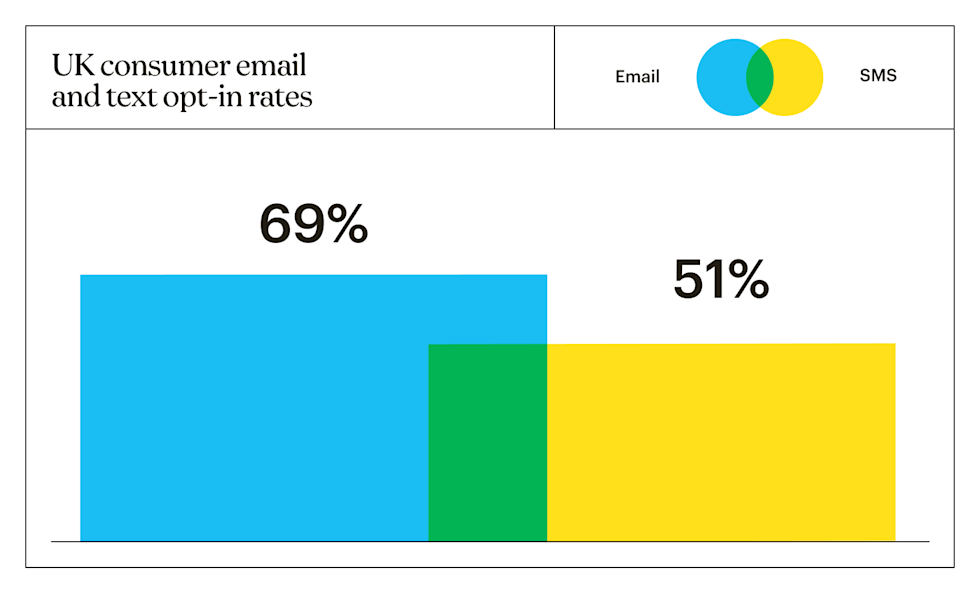
Consumers in the UK are opting in at record levels. They are also the most distrustful audience in our global study. According to The Art of the Opt-In, a 2026 study from Intuit Mailchimp and Ascend2, 69% of UK consumers have opted into brand emails — tying with Canada for the highest rate globally. 51% have opted in to receive text messages. Yet 40% of those same consumers say they do not trust brands with their personal data.
No other region surveyed reports distrust at this scale.
However, UK consumers are not disengaged. They are digitally fluent, privacy-aware, and fully conscious of the value exchange behind every email address or phone number they share.
The message for marketers is clear: opt-in rates may be high, but trust is conditional.
UK subscribers are quick to distrust and unsubscribe
UK consumers expect marketing to justify its place in their inbox. Relevance is the price of admission.
Source: Intuit Mailchimp and Ascend2, The Art of the Opt-In, February 2026
Our data reveals four defining characteristics of the modern UK subscriber:
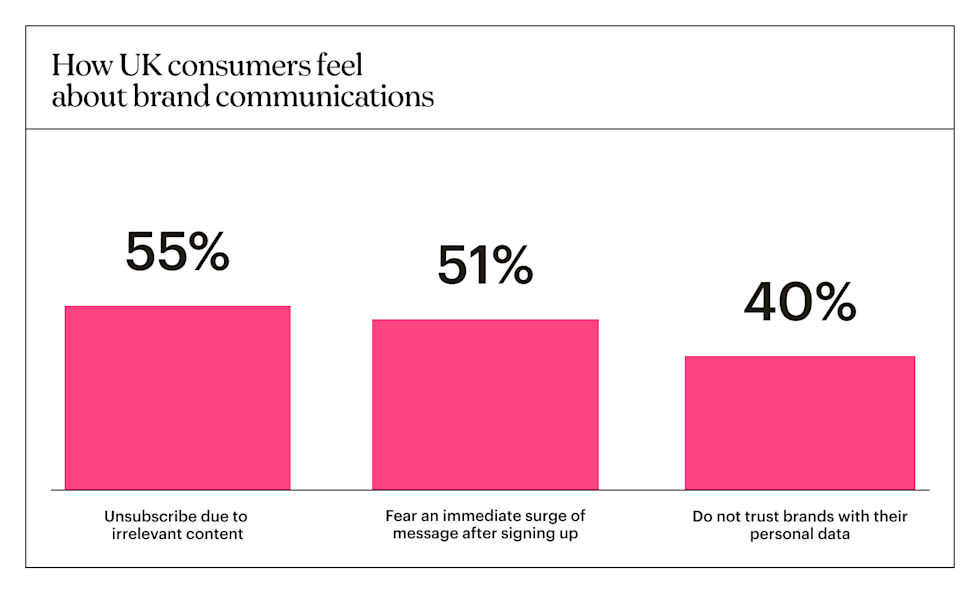
- Trust deficit: 40% do not trust brands with their personal data — the highest globally.
- Overload anxiety: 51% fear an immediate surge of messages after signing up.
- Low tolerance for irrelevance: 55% unsubscribe due to irrelevant content — again, the highest in our study.
- Comfort with friction: 88% are comfortable with a two-step opt-in process.
That last number is particularly telling.
In many markets, marketers fear additional friction. But in the UK, consumers seem to interpret it as reassurance. Confirmation emails are not obstacles; they are proof of legitimacy.
This reflects a broader cultural reality: UK consumers operate in one of the world’s most regulated data environments. GDPR, PECR, and heightened public awareness have shaped expectations. Consent is not cosmetic; it is meaningful.
The UK subscriber expects clarity, control, and value from the very first interaction.
UK marketers are trying to balance conversion with compliance
UK marketers are navigating a uniquely complex environment.
- 41% say getting visitors to complete sign-ups is their top challenge.
- 48% believe better timing and targeting would improve performance.
- 35% cite consent and privacy compliance as a major hurdle — more than any other region.
- 50% are prioritizing more relevant or personalized incentives to drive opt-ins.
Marketers are trying to optimize conversion while managing regulatory scrutiny.
But our research suggests something deeper: legitimacy drives the outcome.
UK brands are ignoring the social contract for clicks
There is a subtle but critical misalignment in the UK market. Consumers are not abandoning forms because they’re too long. They are hesitating because they are unconvinced.
Consumers are asking:
- Why are you collecting this?
- How often will you contact me?
- What will I actually gain?
- Can I change my mind easily?
Marketers are asking:
- When should the popup appear?
- Which incentive converts best?
- How can we reduce drop-off?
Both sets of questions matter, but only one builds long-term growth.
The UK opt-in gap isn’t about popups or incentives. It’s about the psychological contract formed at the moment of consent.
- When 51% of consumers expect an avalanche of messages, silence on frequency becomes a liability.
- When 55% unsubscribe due to irrelevance, generic onboarding becomes revenue leakage.
- When 40% don’t trust brands, vague data language becomes a churn trigger.
In the UK, compliance has become a visible expression of brand integrity.
Next steps for UK marketers
The brands that will win in the UK won’t treat consent as a checkbox. They will embed it into their growth strategy.
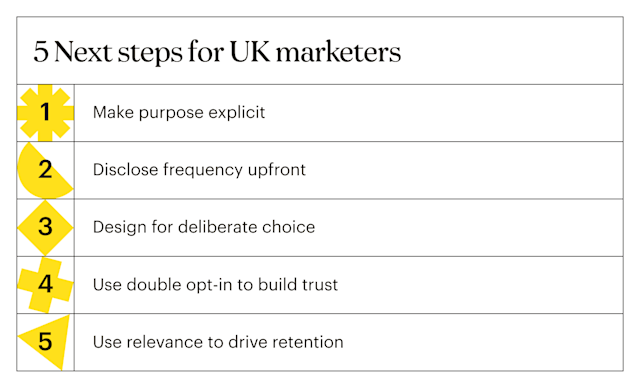
Based on the data, five principles emerge:
1. Make purpose explicit
Explain clearly what subscribers will receive and why their data is required.
2. Disclose frequency upfront
If consumers fear overload, be clear and direct. State how often they will hear from you, and honour it.
3. Design for deliberate choice
Avoid pre-checked boxes or vague language. The UK audience values transparency over speed.
4. Use double opt-in to build trust
With 88% comfortable with two-step confirmation, this is an opportunity to reinforce credibility.
5. Use relevance to drive retention
In a market with the highest unsubscribe rates due to irrelevance, segmentation and behavioural targeting are essential.
The future of UK opt-in strategies
The UK market has high expectations for data use and brand accountability.
Opt-in rates show that consumers are open to brand relationships, but distrust levels indicate that those relationships are fragile.
This tension represents a turning point.
Brands that continue to optimize for volume alone will see churn accelerate. Whereas brands that build trust into their acquisition strategy will see stronger retention, higher engagement, and better lifetime value.
The future of UK subscriber growth is less about collecting more addresses as it is earning the right to keep them.