Budget Atlanta’s email open rates jumped 4x with segmentation

A rental car franchise jump‑started email by sending to the people most likely to engage.

Published: November 2026 – Travel Services – Atlanta, US – 889,000+ subscribers
Travelers land at airports across the United States every day, walk up to a rental counter, and drive off in a car that gets them where they need to go. Behind a good number of those counters is Budget Atlanta, the largest Budget Rent a Car franchise in the US.

The company that began as a single Atlanta location roughly 50 years ago has grown into an operation of around 50 locations. It's still family-run: founder's daughter Jennifer Gelder serves as Chairman after more than 20 years in marketing, and Emilie Hanes leads marketing day to day.

Across 7 markets, from Atlanta to Salt Lake City, the marketing team works toward one goal: "Reservations," Jennifer says.

For years, email was one of marketing’s most dependable ways to drive bookings, with a direct line to renters built around a monthly offer worth acting on.

But seemingly out of nowhere, email stopped pulling its weight. The team watched email revenue slip in their monthly reports without a clear reason why, and began to question whether a channel that had once been a top performer still belonged in how they reached customers.

With Intuit Mailchimp already in hand, Budget Atlanta set out to understand what had changed and rebuild email into a channel they could rely on.

The challenge: A large list that wasn’t opening emails

For most of its history, Budget Atlanta built email campaigns and sent them to the entire contact list, with no segments and little distinction between a subscriber who opened every message and one who hadn't engaged in years. Every offer went to everyone.

"Before, it was sort of like sending it out into a black hole," Jennifer says.

As performance slid, the marketing team didn't know how to find the cause. They wondered whether a recent website redesign had changed how traffic was logged in Google Analytics, or whether email had simply run its course. They had even tried segmenting their audience the year before, though more as an experiment than a strategy aimed at the dip they were seeing.

What they knew for certain was that one of their most reliable tools for driving reservations had gone quiet, and the reason wasn't obvious from the inside.

“You don't know what you don't know, and our CSM was able to share a lot more insight into the tool and how we could set things up differently.”

- Emilie Hanes, Marketing Director, Budget Atlanta

The tools: Segmentation, A/B testing, and a Customer Success Manager

Results began improving when Budget Atlanta reached out to Mailchimp and started working closely with their dedicated Customer Success Manager (CSM). That platform they'd relied on for years could do more than they'd been asking of it, it turned out.

“You don't know what you don't know, and our CSM was able to share a lot more insight into the tool and how we could set things up differently,” Emilie says. “We were already paying for the service; we just weren't taking advantage of all that it had to offer.”

With that guidance, the team rebuilt their audience around the idea of sending to the people most likely to care. Rather than one undifferentiated list, they built segments based on recent activity and engagement, with a separate segment for each of their 7 markets.

They focused on subscribers who had been active within the last 90 days, then widened the window as the approach proved out. Every campaign suddenly had a chance to reach renters who actually wanted to hear from them.

To sharpen what those segments received, the team paired segmentation with A/B subject line testing. They realized that renters often don’t know what a fair rental car price is, so messaging with a clear “15% off” lands better than a daily dollar rate. The insight made campaigns easier to write and more likely to connect.

Running email across 7 markets means 7 versions of every send, each with its own logo, rates, and contact details. Instead of rebuilding each one, the team now works from a reusable template, copying it and swapping only what's unique to each market—work they now handle entirely inside of Mailchimp.

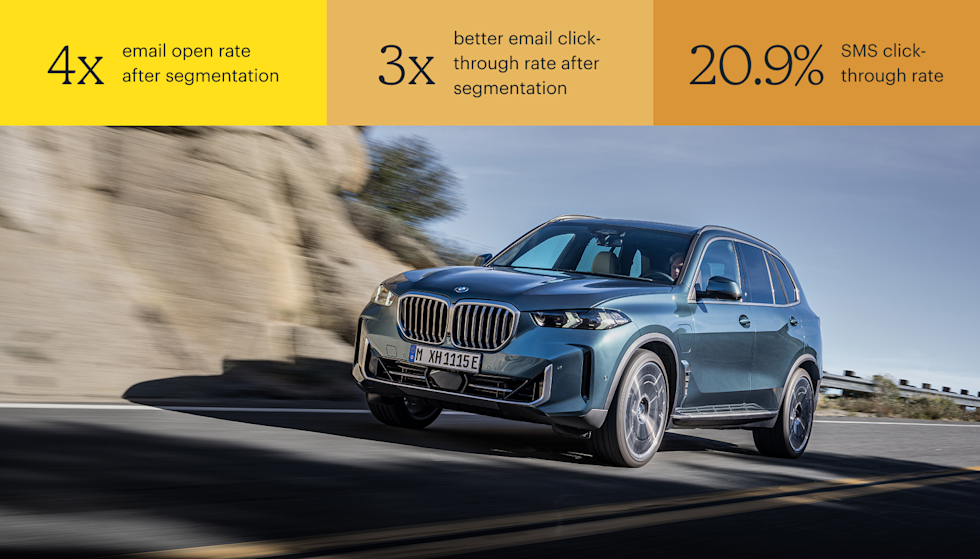
  • 4x

    email open rate after segmentation

  • 3x

    email click-through rate

  • 20.9%

    SMS click-through rate

The results: A 4x jump in open rates

After the team began sending to engaged segments, email open rates rose up to 4 times what they had been before. The jump was steep enough that the team checked the data twice before believing it.

“We were really shocked that it was such a significant jump, because I was like, ‘oh, this is actually working,’” Jennifer says. “We're always a little hesitant to believe the analytics, but it gave us hope that we could build the audience back up.”

Engagement followed. Segmented campaigns reached a 2.1% email click-through rate, a sizable gain over the sub-1% rate of the old full-list sends.

The momentum carried into a new channel. On a recommendation from their dedicated CSM, they tested SMS Marketing in Atlanta, their largest market, where a campaign drew a 20.9% click-through rate. The result pointed to real potential in a new channel they're still exploring, with more SMS tests planned across other markets.

Budget Atlanta now has a much stronger foundation for email. With trusted segments and a clearer understanding of what resonates, the team is starting to think beyond monthly promotions. The audience that began deliberately small keeps widening campaign by campaign, and they plan to grow it as long as engagement holds.

“It's been really nice to know that we can get back to sending to a lot more people,” Jennifer says.

Reach the right audience with segmentation

Share This Article