


The holiday marketing season gets louder every year. More brands, more emails, more texts, all competing for the same shrinking sliver of shopper attention between Halloween and New Year's Eve. So what actually breaks through the noise?
Mailchimp set out to answer that question with data. We analyzed 44 billion email messages and 83 million text messages sent by Mailchimp customers during peak season 2025 (October 31 to December 31). During that 62-day stretch, Mailchimp customers on free and paid plans with connected ecommerce accounts generated $1.1B+ in gross revenue and 7.5M+ email and SMS orders.
Here are seven holiday marketing trends and statistics from our Breaking Through Peak Season Noise report to help shape your 2026 strategy, from which channel to lean on to when to actually hit send.
Holiday marketing trend 1: SMS is a high-engagement channel
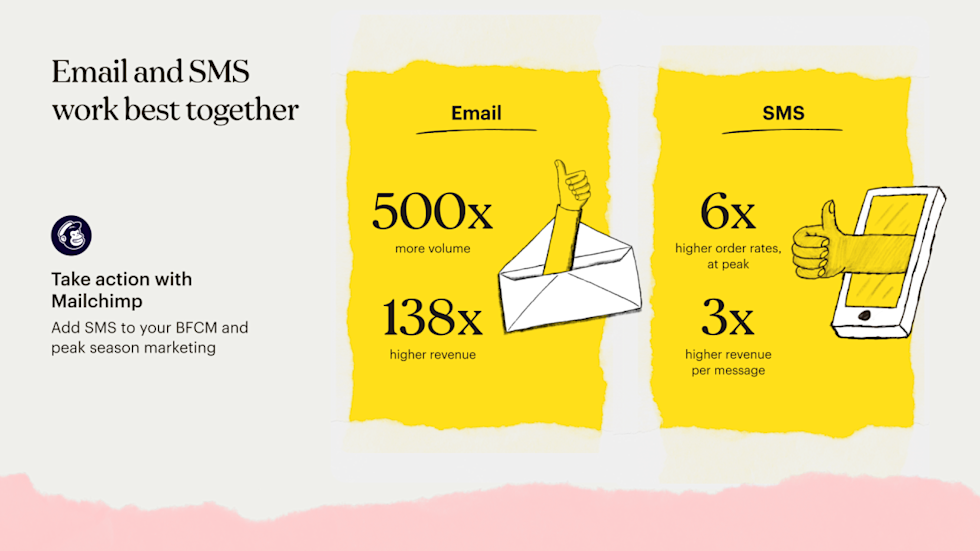
SMS converted up to 6x more often than email at peak. Order rates ranged from 0.03% to 0.25% for SMS, compared with 0.01% to 0.04% for email. SMS also had 3x higher revenue per message, and shoppers clicked text messages 8x more than email per message delivered.
Email still moves more total dollars during peak season, mostly because brands send so much more of it. Mailchimp customers sent over 500x more marketing emails than text messages last peak season, and overall, email drove more gross revenue and revenue per order than SMS.
SMS isn't a replacement for email, but if you haven't built out a text message marketing program yet, it's likely the fastest engagement lift available for a relatively smaller effort.
Holiday marketing tip: As a first step, turn email subscribers into SMS subscribers. And give website visitors an opportunity to subscribe to text message offers via a popup form with a clear description of what they’ll get via SMS.
Trend 2: Email and SMS engagement tapers as the season goes on
Email click rates fell from 2.40% on Veteran's Day/Singles' Day (November 11) to 1.23% on Christmas Day (December 25). Conversion rates across both email and SMS peaked during Cyber Week before tapering off for the rest of the season.
Some shoppers say they feel fatigued as the season goes on. In Mailchimp's The New Ecommerce Calendar report, 39% of global shoppers said they feel overwhelmed by the number of sales and deals, and 25% said they avoid shopping during big sales events altogether.
Most brands respond to fading attention by sending more email. But the brands with the highest engagement (the top 10% by click rate) sent 56x fewer emails than everyone else during Black Friday Cyber Monday (BFCM) and still averaged a 10% click rate, compared with 1.2% for all other senders. Top 10% performers were classified using trailing 12-month click rates prior to BFCM 2025. Click rates and send volume comparison (56x fewer emails) reflect email campaign activity between November 26 and December 1, 2025, comparing the top 10% cohort to all other senders.
Holiday marketing tip: If your engagement is already strong, sending fewer (and more targeted) messages may beat sending more. Segment your audience and tailor your messaging rather than pushing more frequent full-list sends.
Trend 3: BFCM-adjacent days see less competition and better engagement
Surprisingly, the shoulder days, the days surrounding BFCM, outperformed the core weekend itself. Mailchimp customers saw higher average email open rates and higher email and SMS click rates on these days than during BFCM. Sunday, in particular, is wide open. On Sunday, November 30, 2025, Mailchimp customers sent 59% fewer emails and 82% fewer text messages than they did on Black Friday.
Black Friday and Cyber Monday are still enormous shopping days. 75% of global shoppers made a purchase on Black Friday, and 37% did so on Cyber Monday, according to Mailchimp's Holiday Shopping Unwrapped report. But that same demand is what makes the weekend the hardest place to stand out.
Sending engaging SMS messages is one way to stand out during BFCM this year. According to our data:
- Black Friday texts totaled 5.4M, well above the peak season daily average of 1.125M, compared to email’s 1.39B messages sent that day.
- Despite the higher send volume, SMS averaged a 15.7% click rate per message delivered, compared with 1.4% for email.
- For brands sending both channels, SMS drove nearly 20% of total combined e-commerce revenue ($1.6M of $8.2M), a bigger share than for brands sending SMS alone.
Holiday marketing tip: Don't rest on the quiet days during BFCM weekend in particular, and combine your email and SMS strategies for a bigger impact.
Trend 4: Weekends outperform weekdays for orders
Order rates were 2x higher on weekends than weekdays during peak season 2025, even though the calendar didn't cooperate: 11 of the 12 key shopping days in 2025 fell on weekdays. Mailchimp customers still saw their highest email and SMS order rates on weekends.
Yet most brands send less on weekends. Mailchimp customers cut weekend send volume by roughly 60% compared with weekday volume last year, pulling back right when shoppers were most ready to buy.
Holiday marketing tip: Keep up with your subscribers on the weekend with flash sales, SMS reminders, and holiday-specific promotions.
Trend 5: New customers spend more than repeat customers
New customers didn't just show up during BFCM 2025, they spent more once they got there. New email customers had a 21% higher average order value than repeat customers ($157.83 vs. $129.90), and new SMS customers had a 39% higher average order value than repeat customers ($157.68 vs. $113.11). New customers made up 59% of email orders and nearly 70% of SMS orders over the weekend.
They also kept coming. From October 31 to December 31, 2025, Mailchimp customers added more than 500M new contacts (516.8M email, 20.6M SMS), with SMS opt-ins spiking 4-5x the average daily rate in the days just before Black Friday. Unsubscribes stayed modest at 31M, about 6% of total new contacts added. And 16.6% of new customers acquired during peak season 2025 purchased again in Q1 2026, with a median of 26 days to repurchase.
Holiday marketing tip: Treat peak season and BFCM as a way to fill the top of your funnel, then nurture any new customers into loyal brand advocates throughout the year.
The Art of the Opt-In Explore actionable insights to help build opt-in form experiences that balance customer expectations with business goals, so you can create lasting relationships and drive revenue growth.
Trend 6: Intelligent marketing delivered returns, but most brands aren’t using it yet
Intelligent marketing is when you use AI and automation to segment and personalize messages at scale. Despite widespread use of AI among ecommerce brands—58% of retail and CPG organizations use AI, according to NVIDIA research—many brands aren’t taking full advantage of AI to improve their marketing.
Those brands using their data to run intelligent marketing strategies saw it pay off:
- Emails using generative AI during BFCM season 2025 saw a 50% higher order rate and a 33% higher average conversion rate than standard sends.
- Emails that used segmentation drove 11% higher average order value during BFCM 2025 ($166.16 vs. $149.54).
- Emails that used personalization drove 11% higher average order value during BFCM 2025 ($165.99 vs. $149.50).
- Automated abandoned cart emails saw a nearly 36% higher open rate and a 28% higher click rate.
- SMS segmented messages saw 6% higher click rates.
Intelligent marketing offers a way for brands to stand out and better connect with their audiences—only 6B+ of the 44B+ emails sent during peak season 2025 used personalization, meaning the majority of brands still send one-size-fits-all blasts to their entire list.
Holiday marketing tip: Experiment with intelligent marketing. Try using generative AI to create variations of your emails and text messages for different segments and audiences, and personalizing messages with content like personalized product recommendations.
Trend 7: Some holiday milestones are more important than you might think
Black Friday and Cyber Monday get most of the attention, but they weren't the top performers for engagement.
Veteran's Day/Singles' Day (November 11), Halloween, and Pre-Thanksgiving Day had the highest email click rates of any peak season dates in 2025.
For SMS, Cyber Monday, Veteran's Day/Singles' Day, and Boxing Day topped the list.
If your 2026 calendar only has the obvious dates circled, you might be missing some of your highest-engagement moments.
Holiday marketing tip: Many subscribers join your list for the best promotions, subscribing ahead of key sales days. But they may not engage until days with major promotions like Pre-Thanksgiving Day or Cyber Monday. Keep up with new subscribers and create specific messages for each holiday, no matter how minor it may seem.
Stand out this peak season with intelligent marketing
Peak season 2025 pointed to one clear theme: brands that used their data to send smarter messages, not just more, came out ahead. Segment your list, automate moments like abandoned cart follow ups, build out SMS if you haven't already, and don't assume the loudest days are your best ones.
Full day-by-day email and SMS performance for all 12 key peak season dates is available in the complete Breaking Through Peak Season Noise report.
Mailchimp's email marketing, SMS marketing, and AI marketing tools can help you segment, personalize, and automate your way through peak season without doing it all by hand.
Try Mailchimp free for 14 days to get your 2026 strategy in place before the season starts.
All stats reflect internal aggregate Mailchimp data from active free and paid plan users, peak season 2025 (Oct 31–Dec 31, 2025) and BFCM 2025 (Nov 28–Dec 1, 2025). E-commerce metrics apply only to users with a connected store. Full methodology and disclaimers are available in Breaking Through Peak Season Noise. Past performance does not guarantee future results. Individual merchant results, campaign performance, and revenue impact will vary based on industry, audience size, channel strategy, and execution.