JungKwanJang Got Out of Spam Folders by Switching to Mailchimp

See how the premium wellness brand migrated from an expensive, fragmented platform to Mailchimp and recovered $21,000 in revenue in 2 months.

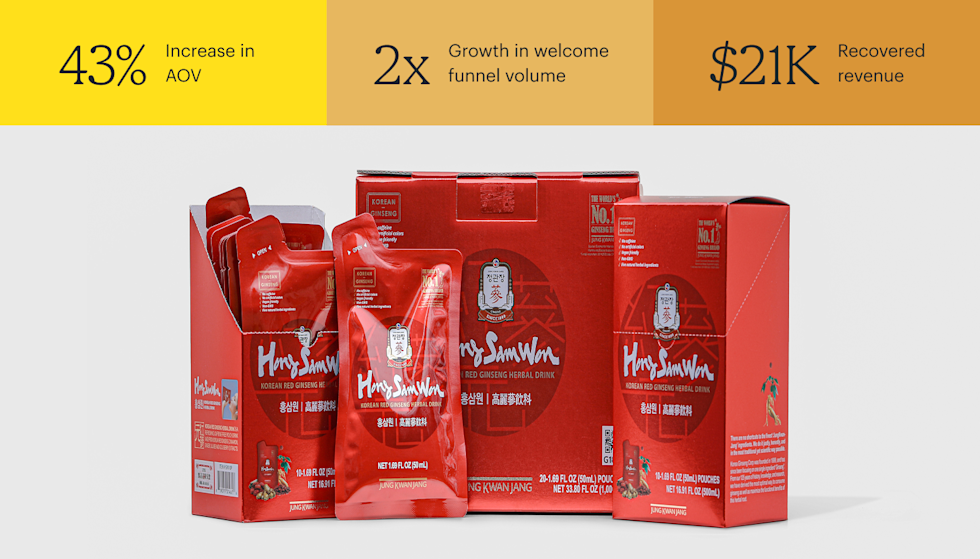
Studio product image of red HongSamWon Korean red ginseng herbal drink packaging, including individual drink pouches and multiple box sizes, arranged side by side on a light gray background with labels facing forward. Stats on top are: 43% Increase in AOV, 2x Growth in welcome funnel volume, and $21K+ Recovered revenue.
Published: March 2026 — Health & Wellness — California, US — 186,000+ subscribers
For over a century, JungKwanJang has been the gold standard in perfecting Korean Red Ginseng, evolving from a heritage staple into a global No. 1 Ginseng Brand.

By marrying time-honored cultivation with modern scientific research, the brand has successfully introduced traditional Asian wellness to the Western market. Today, through its California-based e-commerce operation, JungKwanJang delivers a curated suite of premium ginseng-based supplements to a new generation of health-conscious American consumers.

But they had a problem: Their messages weren't making it to their customers’ inboxes. The brand was paying up to $20,000 a month for an email platform that had campaigns landing in spam, data sitting locked behind paywalls, and their 186,000+ subscribers rarely seeing what the company was sending. 

Alan Han, Online Marketing Platform Specialist at JungKwanJang, watched as deliverability issues compounded an already struggling strategy—campaigns that did reach inboxes still underperformed due to poor targeting, and average order values (AOV) continued to drop.

"We were stuck in spam for everything," Alan says. "Our strategy was vague, and we had a lot of issues with deliverability."

JungKwanJang needed a platform that could sync cleanly with their Shopify store, reach customers where they actually check their email, and make their data available without the premium price tag. Two weeks after switching to Intuit Mailchimp, their welcome funnel had doubled in volume and their team finally had the data visibility to make fast decisions.

The challenge: Campaigns that went straight to spam

JungKwanJang's old platform wasn't keeping pace with their business. Their Shopify integration had stopped syncing properly, leaving them with a stagnant customer base frozen in 2024 data. As their product catalog and customer preferences evolved, the team was stuck sending to outdated segments that no longer reflected their actual audience.

"We had an agency that helped us with emails, but their strategy was to send it to the whole subscriber list," Alan says. "That was the reason why we think our AOV definitely decreased, as well as we were sent to spam, and we had a lot of issues with deliverability."

The spam folder became JungKwanJang's biggest obstacle; Alan couldn't even see his own company's campaigns in his personal inbox. If the team couldn't receive their own emails, how many customers were missing them entirely?

The platform created too much friction with basic features hidden behind separate paywalls, and the interface lacked transparency. Alan said he often had to reach out directly to support just to find where certain features lived or to access data that should have been readily available. 

Monthly reporting became an hours-long ordeal of jumping between separate tabs and reports to piece together performance data. And the emails they sent were only able to feature a single item, limiting what JungKwanJang could showcase to customers.

As Alan had recently transitioned from content and social media marketing to focusing on email, the learning curve was steep." It was kind of given to me, I just had to do email marketing," Alan says. "It was a little hard to figure out all the logistics and even strategies."

With bills reaching $20,000 per month and results declining, JungKwanJang needed a platform that was transparent, could improve deliverability, and would help their team work smarter.

“We are getting better results for a smaller price—recovering over $21,000 in just 53 days and seeing a 43% jump in our AOV. It has completely maximized our potential and given us the confidence to see how far we can really expand.”

— Alan Han, Online Marketing Platform Specialist, JungKwanJang

The tools: Marketing automation flows, Shopify integration, and segmentation

JungKwanJang's transformation started with migrating their data to Mailchimp, which had the team fully operational in just 2 weeks. 

The transition started in early November. Alan expected the transition to take 90 days, but they were able to launch their Black Friday and Cyber Monday campaigns without missing a beat.

From there, Mailchimp's Shopify integration created a unified view that eliminated the data fragmentation that had plagued their previous setup. Email and e-commerce data now lived in one dashboard, giving Alan immediate visibility into customer behavior without cross-referencing multiple platforms.

Centralized data unlocked smarter segmentation. JungKwanJang could now target customers based on purchase history, browsing behavior, and engagement patterns. The shift from generic sends to precision targeting had an immediate impact on where emails landed and whether customers actually saw them.

Marketing automation flows replaced their underperforming single-product sequences. Alan built welcome journeys that introduced new subscribers to multiple products, not just one. He set up browsing abandonment, cart abandonment, and checkout abandonment flows that recovered revenue passively while he focused on strategy. Unlike their previous platform, Mailchimp allowed customers to see multiple product recommendations in email previews, giving them more reasons to engage.

Mailchimp's educational resources helped Alan grow from a content creator learning email marketing into a confident strategist. "Because Mailchimp has a lot of seminars and help, everything is really laid out for complete beginners," Alan says. "That made me a lot more comfortable on this platform and faster."

  • 43%

    Increase in AOV

  • 2x

    Growth in welcome funnel volume

  • $21k+

    Recovered revenue in 53 days

The results: Higher order value and recovered revenue

JungKwanJang's AOV jumped 43%, quickly climbing from $175.52 on their previous platform to $251.00 on Mailchimp. By reaching the right customers with relevant product recommendations instead of blasting everyone with generic messages, the brand attracted higher-intent shoppers who spent more per transaction.

In the first 50 days after migration, welcome flow entries more than doubled, growing 113% on Mailchimp. Alan attributes the surge not just to better data syncing, but Mailchimp's superior deliverability that moved campaigns from spam folders into inboxes where customers could actually see them.

And those Black Friday and Cyber Monday sales Alan was worried about being able to launch in time after the switching to Mailchimp? They generated $127,000 in revenue.

Meanwhile, abandonment flows delivered prompt passive revenue recovery.

“We are getting better results for a smaller price—recovering over $21,000 in just 53 days and seeing a 43% jump in our AOV,” Alan says. “It has completely maximized our potential and given us the confidence to see how far we can really expand.”

Getting that revenue back required zero manual intervention once the flows were built, and monthly reporting that used to take hours now takes one.

With that green light, Alan is building on his victories. He’s diving deeper into customer data to create even more sophisticated segmentation strategies that move beyond a standard playbook of welcome series and abandonment flows.

For a brand built on a century of wellness tradition, JungKwanJang now has the modern marketing infrastructure to match their ambitions, and the confidence to see how far they can expand.

Recovered abandoned revenue

Share This Article