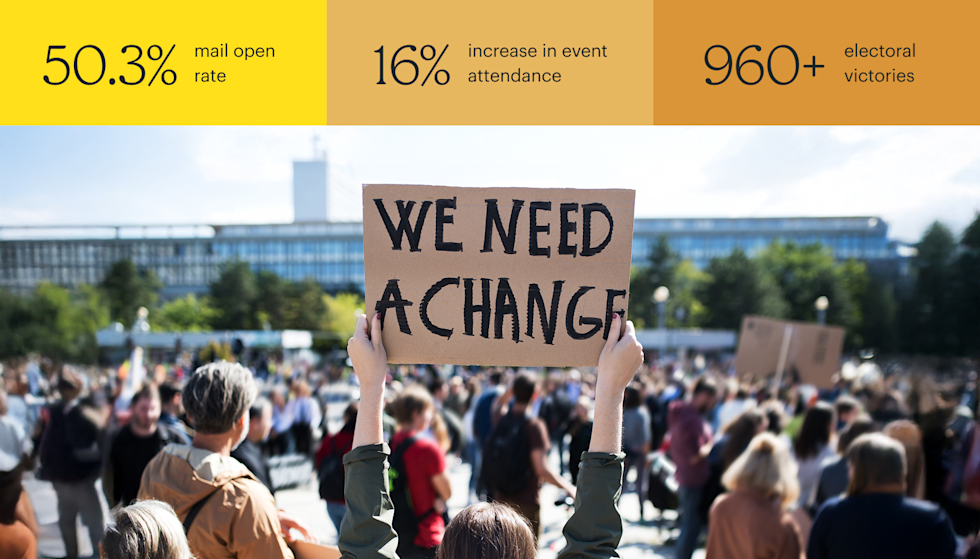
Running for office shouldn't require a large contact list of donors or a degree in political science.
That's the promise behind the work of the National Democratic Training Committee (NDTC), the largest Democratic campaign-training organization in the US. Since 2016, they've trained more than 125,000 people, from mayoral candidates to school board hopefuls and volunteers, through free, accessible courses designed to help anyone learn how to run for office.
In 2025 alone, a so-called “off year,” they supported 1,400 candidates across the country.
But getting aspiring candidates from a signup form to a winning campaign required solving a problem many nonprofits face: How do you communicate meaningfully with tens of thousands of people when your audience includes everyone from first-time volunteers to seasoned campaign managers?
"We were basically sending everything to everybody all at once," Director of Marketing and Communications Sohini Baliga says. No segmentation by region, no targeting by interest, no automation to guide new learners through their first training. "That is not gonna work,” she says.
NDTC switched to Intuit Mailchimp and partnered with their Customer Success Manager to overhaul their contact list’s architecture. But before they could build a system that worked, they had to figure out why their old one was failing.
The challenge: Mass emails with poor engagement
NDTC’s previous enterprise platform lacked flexibility.
"Enterprise systems are great, but they don't necessarily work for everybody," Sohini says. "We needed to reach our people where they were, be able to segment, be able to slice and dice the audience, because what works in Omaha is not what's going to work in Portland, Maine."
The platform couldn't target by metropolitan region, only by city. That meant missing everyone in surrounding suburbs and neighborhoods who might want to attend a local training. When NDTC wanted to promote an in-person event, they had no way to reach a larger geographic audience without manually selecting dozens of individual cities.
Nor could they segment based on who they wanted to talk to at a given time. First-time volunteers would get the same emails as mayoral candidates.
“We wanted to be able to give our learners a really good experience when they sign up for our mailing list, so that they feel like they're only getting what they want, and not a lot of what they don't," says Ada Recinos, Associate Director of Marketing and Communications at NDTC.
The undifferentiated contact list had become a liability. When Sohini arrived at NDTC in September 2024, she discovered that 75,000 of the organization's 109,000 contacts were either unsubscribed or completely inactive. Those extraneous contacts depressed deliverability rates and made it impossible to understand true engagement.
A sunsetting campaign removed many of their inactive contacts.
"Anyone who thinks it's a relief to see that decline in numbers, I admire them," Sohini says. "Because nobody ever wants to hear that your numbers have gone down. It never looks or feels good, even though you know it's the right thing to do."
NDTC also wanted to track how learners moved from clicking an email to completing a course in Docebo, their learning platform, but the systems didn't naturally talk to each other. Without that intentional connection, they couldn't identify which marketing efforts drove people to show up for a live virtual training.
"We live in an attention economy, we have very busy inboxes across the board," Sohini says. "We have lived through a particularly fractured media landscape that continues to evolve. Every marketer knows this—you just kind of have to move with it."