Priority Bicycles Triples Abandoned Cart Conversions

The e‑commerce company used Mailchimp’s Shopify integration to target high‑intent customers.

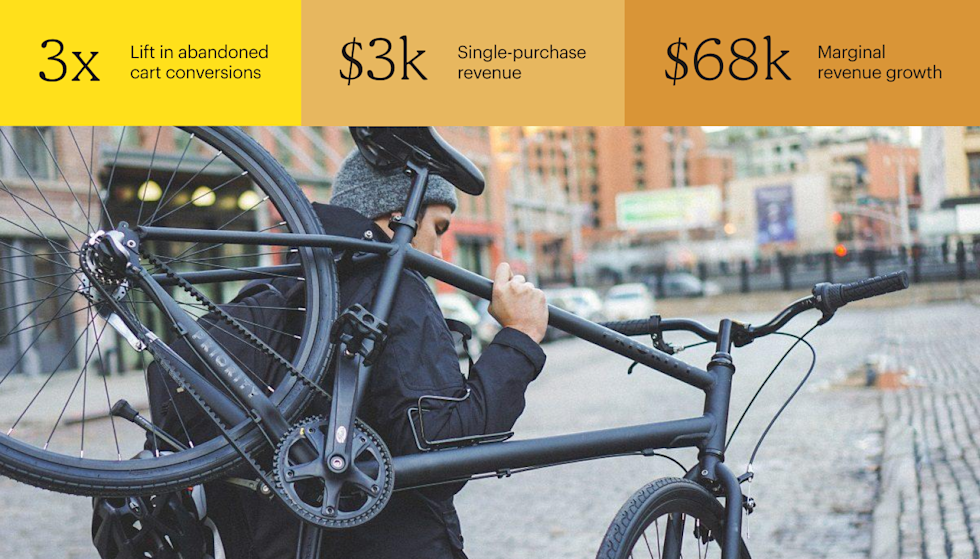
A man in a black jacket and gray beanie holds a black bike over his shoulder as he looks down a cobblestone street lined with shops. The stats on the image are: 3x lift in abandoned cart conversions, $3K single-purchase revenue, and $68k marginal revenue growth.
Published February 2026 – E-commerce – New York City, US – 120k+ subscribers
The founders of Priority Bicycles know that finding the right bike can be a life-changing experience, whether you’re commuting or cruising, on the road or in the mountains. 

The co-founders met in college, and 10 years after graduation, Priority Bicycles was born out of a need for high-quality, low maintenance bikes, sold direct-to-consumer.

As the company has grown in their 11 years, they found a need to increase gears on their e-commerce marketing strategy. Connor Swegle, co-founder and CMO, says that while platforms and tools help them connect with their customers, he understands that behind every purchase is a real person. 

“Human beings are not algorithms. They're not robots. And the way that they may find a product, the way they research a product, and then the way they purchase a product could all be very different, non-linear experiences,” he says. “It’s important that we put the right message out there that answers a customer’s needs, which help them make a purchase.”

And for a lot of customers, that means they linger on making a purchase, showing high intent to make one by viewing the product and even putting it in their shopping cart. At this bottom stage in the sales funnel, Priority Bicycles was missing out on high-revenue sales, and faced the challenge of converting the customers who hadn’t yet hit the “buy now” button. 

We sat down with Connor to see how they were able to capture those customers, and revenue, using Intuit Mailchimp.

The challenge: Capturing revenue where it counts

With an average order value often reaching the thousands, Connor says that high-intent shoppers who haven’t purchased yet represent a significant loss of potential revenue. Not only that, they lose their marketing spend when customers leave before buying.

Priority Bicycles realized there were a few hurdles keeping them from securing those important last-mile conversions.

First off, they were relying on broad email messaging sent to their entire contact list. The emails weren’t being opened and acted upon, which can affect their sending reputation and deliverability, preventing messages from reaching inboxes. "When you send to your entire list, it's not going to get through to your entire list," Connor says.

Along with this, the team had to craft a marketing strategy to target their most critical audiences. To reach these almost-customers, they needed a people-focused yet data-driven approach with a clear, measurable link between their campaign efforts and e-commerce revenue. 

“The very bottom of the funnel is critical. Having strategic, Shopify-specific campaigns built into Mailchimp helps us convert with confidence every customer we can. We only continue to optimize because we can easily track the revenue uplift.”

- Connor Swegle, Co-founder and CMO, Priority Bicycles

The tools: Shopify integration, segmentation, and marketing automation flows

Connor says that although the transaction is made through Shopify, the real purchase is made in the customer's mind. By connecting their Shopify store data with Mailchimp's automation capabilities, they built a system designed to guide the right people to the right products by understanding their real-life behavior.

Mailchimp’s Shopify integration allowed Priority Bicycles to sync behavioral data like product views, cart additions, and purchase history directly from their e-commerce store into their Mailchimp audience. With that, they can create advanced segmentation and behavior-based automation, and then target customers based on their specific actions and interests. 

“Mailchimp makes us feel confident in that we know we're delivering a message to our most interested customer,” Connor says.

During Black Friday, they tested their new strategy. Instead of sending a general promotion to their entire list, they created a highly-targeted segment representing just 10% of their audience, composed of customers who had recently engaged or shown interest in a specific product.

The campaign sent to this small, engaged segment achieved higher open and click-through rates than the identical campaign sent to the other, larger part of their list. "When you look at having 10% of your list overperform in volume to the other 90%, it shows the power of being able to use those different categories," Connor says.

Armed with that information, they used Shopify integration data to create marketing automation flows, focusing mainly on the abandoned cart flow. 

Instead of a blanket discount, they integrated Coupon Carrier, a Shopify plugin that generates time-sensitive single-use discount codes. With these codes in their abandoned shopping cart emails, they were able to create a sense of urgency for the people who had the highest potential for making a purchase.

  • 3x

    Lift in abandoned cart conversions

  • $3k

    Single-purchase revenue

  • $68k

    Marginal revenue growth

“The very bottom of the funnel is critical. Having strategic, Shopify-specific campaigns built into Mailchimp helps us convert with confidence every customer we can. We only continue to optimize because we can easily track the revenue uplift,” says Connor.

After implementing the new flows, the company saw three times the abandoned cart conversions quarter over quarter. The automated abandoned cart flow featuring a time-sensitive discount code was responsible for a single $3,000 purchase that would have otherwise been lost.

They ran an 8-day ad campaign to sell product bundles, followed up with an email campaign targeted only to high-intent shoppers. They spent the whole promotional period building a targeted group of interested shoppers, and then gave that group a final push at the end to urge them to purchase, generating over $68,400 in marginal revenue from selling 38 bundles. 

With everything they’ve learned using Mailchimp and the Shopify integration, Connor has advice for e-commerce business owners. “Look at product-level interest,” he says. He goes on to say that looking at sitewide visitors can be misleading. Web traffic can come from a variety of places without saying anything about intent to purchase. But looking at product-level conversions can help identify the customers to focus on.

"Mailchimp is the platform where you can directly do that, and the tools are right there in front of you to be able to better connect with those customers directly," says Connor.

Ready to convert more customers?

Get Mailchimp’s Shopify integration now.

Share This Article