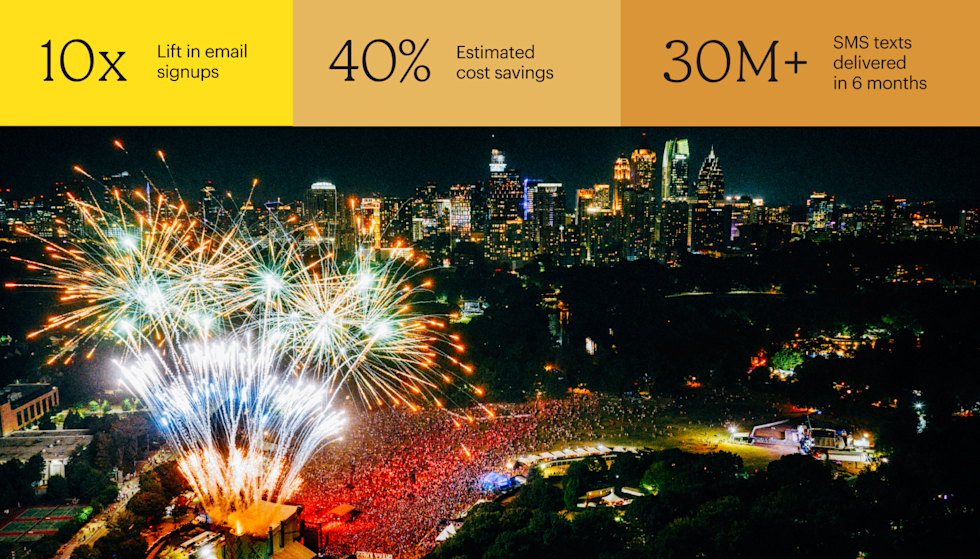
If you love music, chances are you’ve been to a C3 Presents event. A subsidiary of Live Nation Entertainment, they produce 30 festivals and events throughout the year, like Austin City Limits Music Festival, Lollapalooza, Bonnaroo, and more.
Their business revolves around a festival lifecycle where tickets are primarily purchased in phases: presale, pre-event, event, and post-event. C3 Presents sells most of their tickets on the first day of sales, but they also focus on selling more tickets faster during each phase.
SMS is C3 Presents’ highest-revenue channel, which drives more ticket sales than all their other marketing channels combined. With their large number of festival brands and more than 6 million subscribers, they needed a platform that could support their complex SMS marketing strategy, protect their main source of revenue, and prioritize the fan experience.
While they’ve been a longtime user of Intuit Mailchimp email, they only recently consolidated their SMS into the Mailchimp platform in May 2025. We sat down with Director of Strategy and Insights Eric Klein, Marketing Technology Manager Adam Lundeen, and Digital Strategy Manager Jun Yung to find out how they were able to use Mailchimp’s unified email and SMS platform to help them reach their goals.
The challenge: Unifying a disparate marketing system, decreasing cost, safeguarding their most important revenue driver, and creating a great fan experience
In C3 Presents’ previous email platform, and in other platforms they’ve considered moving to, 30 events meant they had 30 different accounts, and Eric says that it resulted in a series of problems.
“It created overhead in terms of user management, and worsened the overall marketer experience in several ways—one of which was being able to easily share assets,” he says. They weren’t able to clone campaigns, instead building each one from scratch, and could only use campaigns in each account instead of using them across multiple ones.
On top of those challenges, their email and SMS were on different platforms. Adam notes that for marketers who manage multiple festival audiences, this complex and inefficient workflow created more work for the team. Marketers had to sign in to multiple accounts, plus an SMS platform just to give them a picture of how the events were performing, and something as simple as giving a marketer access to several audiences took more time.
Not only was managing events inefficient, they wanted to improve the fan experience. In their previous platforms, fans had to sign up for SMS and email separately, which meant they collected significantly fewer email addresses. They needed a way to ensure they could send more detailed information through email, or links to announcements or presales if the fan preferred it.
Additionally, they only used a single short code with their previous provider, and opting out of one event cancelled all event messages.
The single short code also presented a compliance risk. If anything happened to their SMS channel, they jeopardized ticket revenue during their essential sales windows. "I always felt nervous,” Eric says. “If there was any kind of problem with a carrier on that one code, it could have shut down all our communications for all festivals."