Most marketing teams don't struggle with execution. They struggle with deciding what to do next. Which audience segment should you prioritize this quarter? What's the right cadence for a re-engagement campaign? Should you lead with email or SMS or both?
These are strategy questions, and until recently, answering them meant either hiring a consultant or spending hours combing through performance data on your own. But generative AI is changing that equation.
Marketers now have access to AI tools that go beyond writing subject lines or generating images. They can help you think through your entire campaign strategy from start to finish.
The Mailchimp and Claude integration puts that kind of strategic support directly inside your Claude conversations. The Mailchimp Connector in Claude gives you a strategic planning partner that understands your business, your audiences, and what's actually working in your industry.
It covers the full campaign journey from initial concept to audience targeting to channel selection, so you can create workflows, refine your approach, and launch campaigns all from one conversation.
The result is a purpose-built connector that combines Mailchimp's proprietary marketing data with Claude's advanced reasoning to deliver recommendations grounded in real performance.
How Mailchimp works in Claude to build full campaigns together
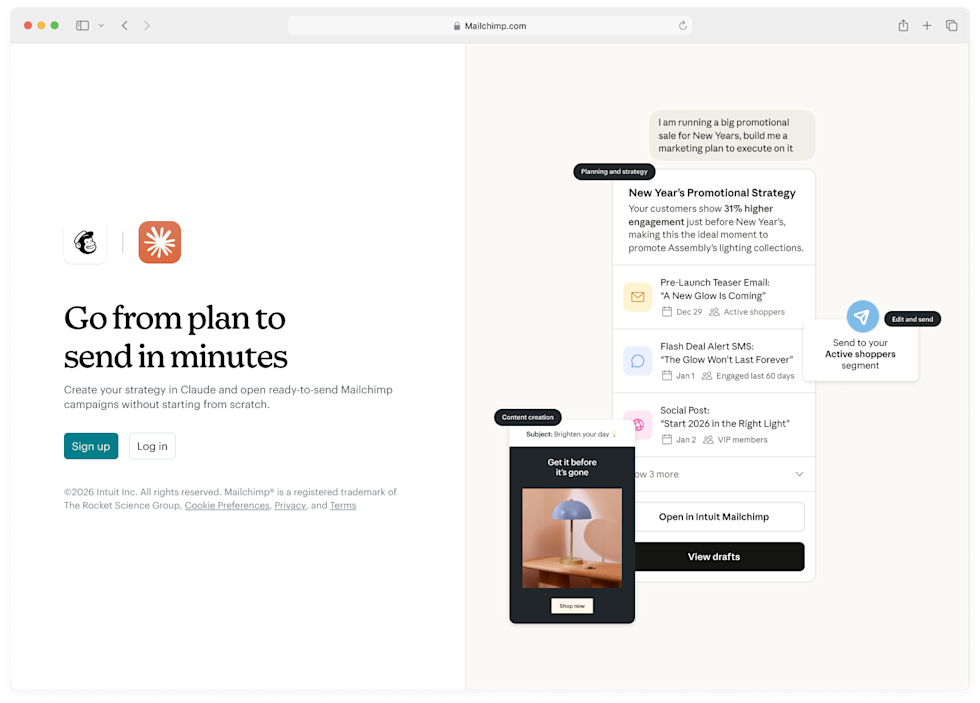
The Mailchimp Claude Connector works like having a marketing strategist available whenever you need one. When you open the connector, you can use Claude to talk through your marketing challenge in plain language and get back a detailed, actionable campaign plan tailored to your business.
The integration covers multiple channels and campaign types. Whether you're planning an email drip sequence, an SMS promotion, or a coordinated push across email and social media, Claude builds recommendations that account for audience targeting, messaging details, and send timing. You get a complete strategy rather than a single-channel suggestion.
Here's what the end-to-end workflow looks like in practice:
- Describe your goal: Tell Claude what you're trying to accomplish; a product launch, a win-back campaign, a seasonal push, or anything else on your calendar.
- Get a full strategy: Claude responds with a recommended approach that includes audience segments, channel mix, content ideas, and a suggested timeline.
- Refine and adjust: Share feedback, ask follow-up questions, or add constraints ("Can you focus this on email only?" or "My budget is limited, what's the highest-impact version?"), and Claude adapts the plan in real time.
- Take it to Mailchimp: Once you're happy with the direction, you can move into your Mailchimp account to finalize and send your campaign with a clear strategy already mapped out.
To show how natural the chat experience feels, here are two example prompts a user might type:
"I need a post-holiday retention plan for lapsed buyers who haven't purchased in 90 days." Claude responds with a multi-touch sequence, likely combining a re-engagement email with follow-up SMS messages, along with subject line suggestions, recommended timing, and segment criteria based on purchase behavior.
"Help me plan a spring product launch for my skincare line across email and social." Claude outlines a phased approach: a teaser campaign to build anticipation, a launch-day push with early access for top customers, and a post-launch follow-up, with audience targeting and content direction for each channel.
See how Mailchimp and Claude work together
The powerful Mailchimp connector makes it easy to bring the things you build in Claude to Mailchimp. Find out how it works and what it can do—it takes just a few minutes and doesn't require signup.
*This demo is based on the Standard Plan and availability of features and functionality varies by plan type. For details, please view Mailchimp's various plans and pricing.
- Mailchimp 101
- Email Marketing
- Claude Integration
*This demo is based on the Standard Plan and availability of features and functionality varies by plan type. For details, please view Mailchimp's various plans and pricing.
How the Mailchimp Connector personalizes your recommendations
What sets this integration apart is how it tailors its recommendations based on where you are as a Mailchimp user. The experience adapts depending on whether you have an established account with historical context or you're brand new to the platform.
For existing Mailchimp users
If you already have an active Mailchimp account, Claude connects directly to your data.
That means the recommendations you receive aren't hypothetical; your actual campaign history, audience engagement patterns, and performance benchmarks inform them. Claude can see which campaigns performed well, where open and click rates are trending, and how different audience segments respond.
This makes the advice significantly more specific. Instead of "you should send a re-engagement email," Claude might recommend targeting a particular segment of your list that hasn't engaged in 60 to 90 days, drawing from patterns it found in your account.
The difference between general marketing advice and a plan built around your actual results is significant, and that's what this integration delivers for established users.
For new users
New to Mailchimp? Claude doesn't leave you starting from zero.
When there's no account history to pull from, the integration draws on Mailchimp's proprietary industry data, built from billions of emails sent across millions of businesses, to fill the gap. Even if you've never sent a campaign before, you're getting guidance based on what actually works for businesses in your vertical.
This dual-audience approach is a meaningful differentiator. Most AI analytics platforms only work well once you've fed them enough of your own data. Mailchimp's Claude integration gives both experienced marketers and newcomers high-quality, relevant advice from day one.
How the Mailchimp Connector gives Claude better context
Plenty of marketers have experimented with asking generic AI chatbots for campaign advice. The results tend to be surface-level, vaguely useful tips that could apply to any business in any industry.
The Mailchimp Claude integration delivers something fundamentally more useful because it pairs two things that standalone AI conversations can't replicate:
- Mailchimp's proprietary data: Decades of email marketing performance data across industries, business sizes, and campaign types. This foundation is what makes recommendations specific and credible rather than generic.
- Smarter, more connected responses: Claude doesn't just retrieve information; it synthesizes your goals, your constraints, and Mailchimp's performance benchmarks into a coherent strategy. The output feels like it came from a consultant who actually understands your business.
That combination allows the integration to make concrete, evidence-backed suggestions. You'll get the best send time for your industry, the ideal email frequency for your list size, or data-backed information about which campaign types tend to drive the strongest return for businesses similar to yours.
The integration can also lean on AI predictive analytics to surface trends in your audience behavior and recommend actions before performance starts to dip.
It's also worth noting that Mailchimp integrates with both Claude and ChatGPT. This AI-platform-agnostic approach says something important about our strategy: Mailchimp's focus is on delivering the best possible outcomes for marketers. For users, that means access to AI as a Service options from multiple leading providers.
And when it comes to AI transparency, you'll always understand how Claude arrived at its recommendations. The integration provides clear reasoning behind each suggestion, so you're making informed decisions at every step.
See the Mailchimp Claude Connector in action
To make the value more tangible, here are a few examples of how different business types might use the Mailchimp Connector in Claude:
A retail brand is planning a post-holiday re-engagement campaign
A home goods retailer notices a drop-off in purchases after the holiday rush and asks Mailchimp to help bring lapsed buyers back.
Mailchimp suggests a two-part email and SMS sequence, a personalized "new arrivals" email based on past purchase categories, followed by an SMS with a loyalty reward for returning customers, and recommends sending during the window when the retailer's audience is most active.
A local service business is building its first welcome sequence
A new yoga studio owner with no marketing background asks Mailchimp how to follow up with people who just signed up for a first class.
Mailchimp outlines a three-email welcome series: a confirmation with what to expect, a post-class check-in encouraging them to book again, and a membership offer timed for one week later, all based on benchmarks for fitness and wellness businesses.
An e-commerce store is developing a product launch strategy
A specialty coffee brand is releasing a new single-origin roast and wants to build momentum before launch day.
Mailchimp recommends segmenting their list into past coffee subscribers, high-engagement readers, and new signups, then maps out a teaser email, a launch-day announcement with early access, and a post-launch follow-up highlighting customer reviews, with suggested timing between each send.
Each of these scenarios plays out in just a few minutes with the Mailchimp for Claude integration, and the strategies that come back are ready to act on, not vague outlines you'd need to develop into full projects.
Your smarter marketing workflow starts here
Marketing is entering a new phase. The gap between businesses with dedicated strategy teams and those without is shrinking, and the Mailchimp Connector in Claude is a big reason why. Marketing tasks that used to take a consultant and a week of planning can now happen in minutes, backed by data from one of the largest email marketing platforms in the world.
If you've been sitting on a campaign idea that never made it past the brainstorming stage, this is a good time to test it. The setup takes minutes, just open the Mailchimp Connector in Claude, describe the challenge you're facing, and see what comes back.
Whether you're building a re-engagement campaign, launching a new product, or trying to figure out the smartest next step for your business, the Mailchimp Connector gives you a smarter starting point grounded in real performance data, tailored to your audience, and ready to go.
Get started with the Mailchimp Connector in Claude.