AI has changed the way marketers think about strategy. Instead of spending hours pulling reports, comparing past campaigns, and trying to figure out what to send next, more businesses are leaning on generative AI to handle the heavy lifting up front so they can focus on creating and shipping work that actually performs.
But there's a gap between what most AI tools can do and what marketers actually need. General-purpose chatbots can help you brainstorm subject lines or draft a social post, but they don't know your audience, your industry benchmarks, or what's worked for your business before.
They can assist with everyday tasks, but they can't tell you which campaigns to run, when to send them, or who to target.
The Mailchimp app in ChatGPT acts as a personal AI CMO, a conversational strategy partner that combines Mailchimp's proprietary marketing data with ChatGPT's natural language capabilities.
Whether you're an existing Mailchimp user or someone exploring the platform for the first time, this integration helps you build data-backed omnichannel campaign plans in minutes instead of hours.
What the Mailchimp for ChatGPT integration does
Think of the Mailchimp custom app in ChatGPT as your on-demand marketing strategist. You describe what you're trying to accomplish in plain language, the way you'd talk to a colleague, and the app returns a full omnichannel campaign plan built around your goals.
This isn't prompt engineering in the traditional sense, where you need to craft the perfect input to get a usable response. The app is purpose-built for marketing, so even simple, conversational prompts produce detailed, actionable output. You don't need to be an expert at writing prompts for marketing to get value from day one.
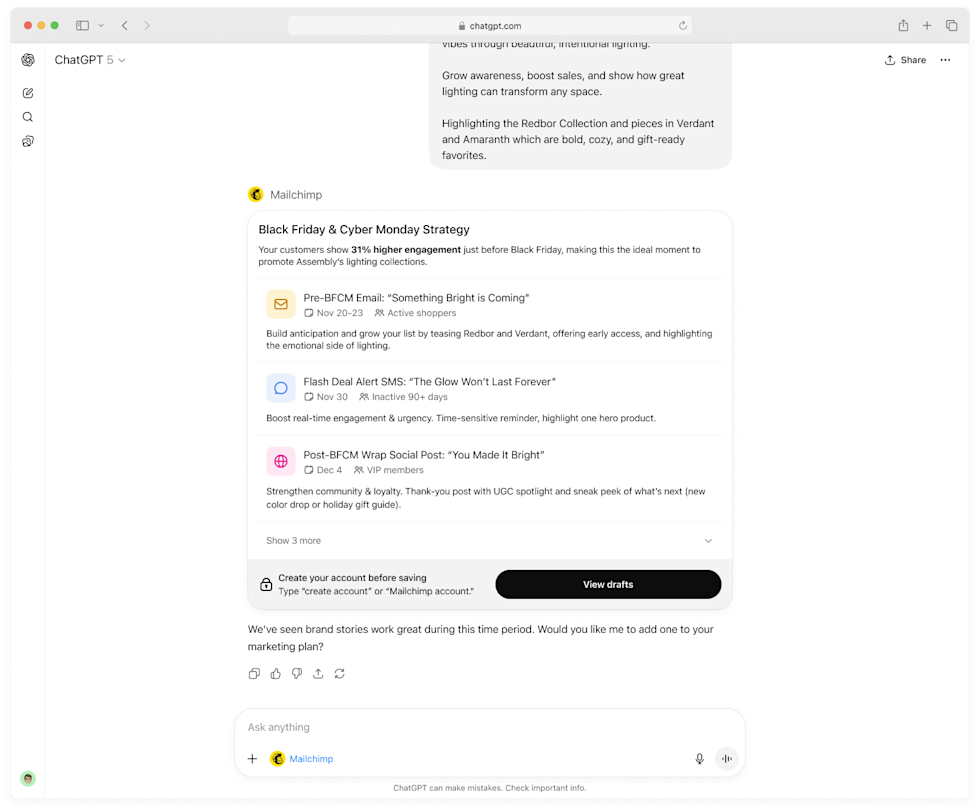
Say you type something like, "I need a post-holiday retention plan for lapsed buyers." The app analyzes the context behind that request and comes back with a complete campaign strategy that covers several things:
- Channel recommendations: A suggested mix of email, SMS, and social campaigns tailored to your goal.
- Timing optimization: Specific send days and times based on when your audience (or your industry's audience) is most likely to engage.
- Audience targeting: Conceptual audience segments for each campaign, such as "high-value lapsed buyers" or "recent first-time purchasers."
- Content direction: Creative outlines, messaging angles, and copywriting starting points for each campaign in the plan.
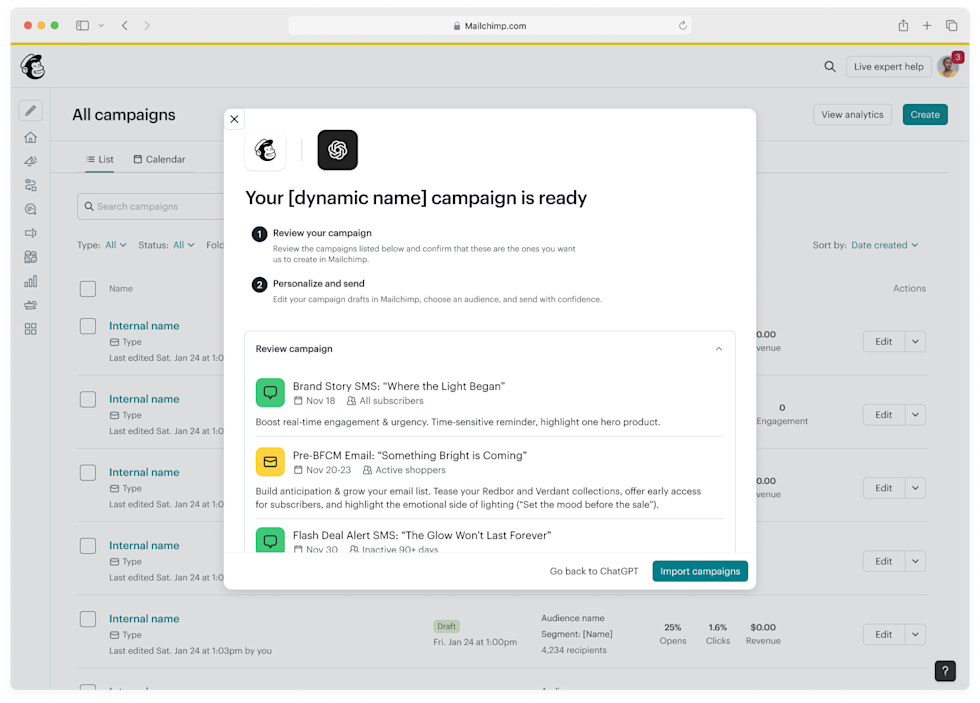
You can also ask follow-up questions or request adjustments in the same conversation. Want to shift the timeline, swap a channel, or add another campaign to the mix? Just ask. The app refines the plan based on your feedback, making it easy to iterate without starting over.
For marketers who already use ChatGPT AI content writing tools for drafts and brainstorming, this integration brings something those standalone tools can't, real marketing intelligence behind every recommendation.
How Mailchimp uses your data (not generic ChatGPT plugins)
One of the biggest differentiators here is how the app handles data. It treats existing Mailchimp customers and first-time users differently, and both benefit from an experience that generic AI tools can't replicate.
For existing customers
If you connect your Mailchimp account, the app pulls from your actual campaign history. It looks at what you've sent before, how those campaigns performed, and what patterns show up in your data. From there, it uses that information to analyze data from your account and deliver tailored recommendations grounded in your real results.
This means the suggested send times, campaign types, and audience ideas aren't based on guesswork or broad averages. They reflect what has actually worked for your business. For marketers who are data-rich but short on time, this is where the integration earns its value; it does the data analysis that would normally take hours of manual reporting.
For new users
First-time users don't have campaign history to draw from, but that doesn't mean they're stuck with generic advice. The app asks a few questions to understand your business, then predicts your industry and applies Mailchimp's proprietary aggregate data, drawn from millions of campaigns across thousands of industries, to build relevant, high-quality recommendations.
This is a significant step up from what you'd get from a standard ChatGPT session. Public AI models don't have access to this kind of specialized marketing performance data, so the recommendations they produce tend to be surface-level.
Mailchimp's integration closes that gap for new users who want a credible strategy without an existing track record. Even ChatGPT users who are comfortable with general-purpose prompting will notice the difference in output quality when Mailchimp's data is powering the conversation.
And your data stays protected throughout this process. Mailchimp has a dedicated agreement with OpenAI, ensuring that customer data is not used to train their models. Connecting the app doesn't hand over your information; it simply allows the app to read your campaign performance so it can give you better recommendations.
Why this ChatGPT app is different with Mailchimp
There are plenty of ChatGPT apps available today, and many of them can help with everyday tasks like writing copy or summarizing content. But when it comes to marketing strategy, most of them fall short because they're working without any real context.
The Mailchimp integration is different because it pairs ChatGPT's conversational abilities with Mailchimp's deep marketing expertise and proprietary performance data. The result is recommendations that reflect what actually works for businesses in your industry, not generic best practices pulled from the internet.
Here's what that looks like in practice:
- Specificity over generality: Instead of vague advice like "send a re-engagement email," the app recommends a specific campaign type, audience, send time, and messaging angle based on proven performance patterns.
- Omnichannel thinking built in: The app doesn't just plan emails. It builds coordinated strategies across email, SMS, and social so your campaigns work together instead of operating in silos.
- A smarter starting point: For anyone who's experienced "blank page" paralysis when sitting down to plan a campaign, this gives you a fully formed strategy to react to and refine rather than building from scratch.
It's also worth noting that Mailchimp has expanded our AI integrations beyond ChatGPT. The platform also works with Claude. If you prefer using prompts for email marketing in one environment and business automation workflows in another, Mailchimp is built to meet you wherever you work.
See the Mailchimp for ChatGPT integration in action
The best way to understand the integration is to see how different businesses might use it. Here are a few scenarios that show the range of what's possible:
- A retail brand planning for post-holiday engagement: A clothing retailer just wrapped a strong holiday season and acquired hundreds of new customers. They ask the app to create a January re-engagement plan for lapsed buyers across email and SMS. The app returns a multi-campaign calendar with targeted messaging for each segment, optimized send times, and content outlines, all grounded in the retailer's past campaign performance.
- A local service business building its first campaign: A home cleaning company with no prior marketing experience connects to the app and says, "I want to get more repeat bookings." The app identifies their industry, pulls relevant benchmarks, and delivers a welcome sequence for first-time customers with recommended timing, channel mix, and messaging themes, giving them a professional-grade plan without needing a marketing background.
- An e-commerce store launching a new product: A skincare brand is dropping a new line in February and wants a full launch strategy. They type, "Help me plan a product launch campaign for next month." The app builds a phased rollout across email and social with audience segments, a suggested cadence, and creative direction for each touchpoint.
Each of these scenarios takes minutes, not days. And because everything happens conversationally, you can adjust and refine until the plan feels right. There's no need to close out and start a new session. Instead, you iterate within the same conversation until your strategy is where you want it.
Start building smarter campaigns today
This integration represents an early look at where AI in email marketing, and marketing strategy more broadly, is heading. The ability to go from a loose idea to a data-backed, multi-channel campaign plan in a single conversation is a meaningful shift in how businesses of all sizes can approach their marketing.
And this is just the beginning. As the app evolves, expect deeper integration with your Mailchimp account, more granular audience mapping, and expanded content generation capabilities. Getting started now means you're already familiar with the tool as it grows, and you'll be ahead of the curve as new features roll out.
There's no additional cost to use the Mailchimp app in ChatGPT, and you don't need to be on a specific plan to access it. Whether you're a long-time Mailchimp user looking to get more out of your data or a new business owner figuring out your first marketing strategy, the app meets you where you are.
Ready to try it? You can find the Mailchimp app in the ChatGPT app store today. Just search for Mailchimp, add the app, and start a conversation about your next campaign.
Note: The Mailchimp app in ChatGPT is currently available in the US only.