


Peak season marketing runs from Halloween through New Year's Eve, and Black Friday Cyber Monday (BFCM) is its biggest weekend. While your marketing strategy for that weekend matters—a weak plan can cost you a large share of your season's revenue and some of your best list-growth days—the other eight weeks matter, too. Inboxes and phone lock screens fill up with promotions during these 62 days, and the brands that break through the noise send at different times, to different people, and on more than one channel.
To see what helped brands last peak season, we analyzed more than 44 billion emails and 83 million text messages that Mailchimp customers sent between October 31 and December 31, 2025, for the Breaking Through Peak Season Noise report. Here are five takeaways from that data to guide your 2026 holiday marketing strategy.
1. Prioritize weekends and the days surrounding BFCM
Some of the best days for peak season messages fall right before and after BFCM weekend. For Mailchimp customers, the days surrounding BFCM 2025 (Wednesday November 26, Thursday November 27, and Tuesday December 2) drove higher average email open rates and higher email and SMS click rates, likely because they were less crowded.
Across the whole season, order rates were also 2x higher on weekends than on weekdays, even though brands cut weekend send volume roughly 60% below weekday levels.
Weekend inboxes carry fewer competing messages, so an audience that’s ready to buy, outside the work week, may pay closer attention to your brand. Similarly, on the days before Black Friday and the days after Cyber Monday, consumers may be ready to look at their busy inboxes again.
A few ways to plan for these days in 2026:
- Send a preview or early-access campaign the day before Thanksgiving.
- Extend your BFCM offer into the Tuesday after Cyber Monday for shoppers who missed it.
- Schedule at least one weekend send during each week of December.
- Send on the Sunday of BFCM weekend, claiming a new shopping moment like “Self-Care Sunday” or “Surprise Sunday.”
2. Focus on VIPs and use your customer data
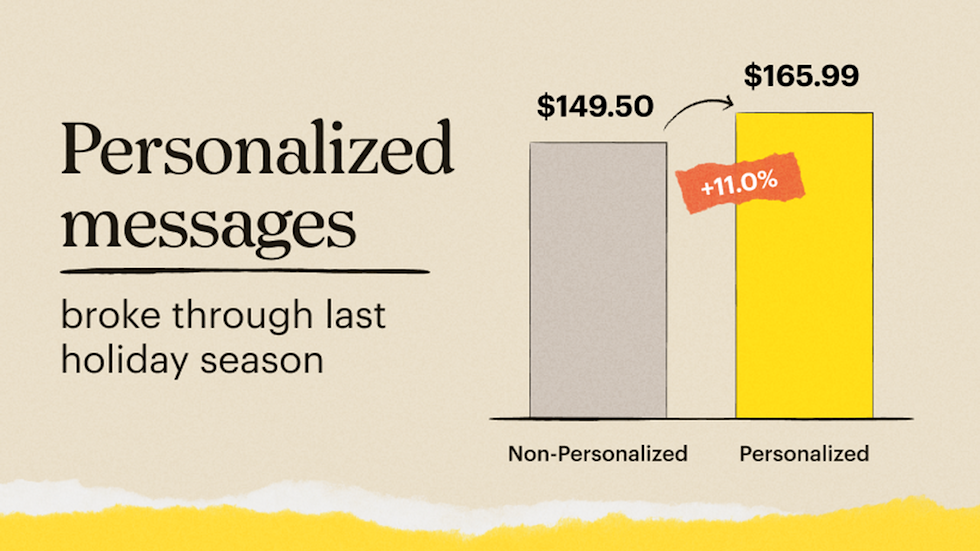
During BFCM 2025, emails that used segmentation or personalization had an 11% higher average order value (AOV) than emails that didn't.
BFCM 2025 | AOV with | AOV without | Lift |
Segmented emails | $166.16 | $149.54 | 11% |
Personalized emails | $165.99 | $149.50 | 11% |
Most brands still send the same message to everyone. A little over 6 billion of the 44 billion+ emails sent during peak season 2025 used personalization, which means most of them went out as one-size-fits-all blasts. A targeted peak season marketing campaign faces much less competition.
Start with your VIPs, the customers who buy most often or spend the most. You can:
- Build a segment of top customers from purchase history and give them first access to your BFCM offers.
- Add product recommendations based on what each customer has bought before.
- Send less to low-engagement contacts instead of including them in every campaign.
3. Lean into generative AI for marketing messages
During peak season 2025, the emails Mailchimp customers built with generative AI had a 50% higher order rate and a 33% higher conversion rate than standard sends.
For a small team, the time generative AI saves can make a big difference. Peak season marketing can mean dozens of campaigns, automations, and text messages. AI can draft subject lines, email copy, SMS messages, and variations for testing, so you can launch faster.
Before anything goes out, review each draft for accuracy, offer details, and brand voice. Mailchimp also integrates with ChatGPT, Claude and Gemini, so you can keep working in the AI tools you already use.
If you’re using generative AI for the first time this year, start with these ideas:
- Ask your AI analytics agent which of last year's holiday campaigns brought in the most revenue and why. Then use those answers to decide what your 2026 messages should look like.
- Open last year's best-performing holiday email and use AI to shorten it, change the tone, or tighten the offer. Then A/B test the new version against the original.
- Draft your BFCM text messages with Write with AI in the SMS builder. Keep the offer and the deadline in the first line.
- Build a welcome flow with AI-generated SMS content for first-time buyers, so new customers from BFCM hear from you within that first month.
- Test AI-generated subject lines and messages in early October. Find the versions that perform best, then use them in your BFCM and December campaigns.
4. Nurture new contacts after the holiday rush
Peak season is prime time for adding new contacts to your list, and many of them will spend more than your regulars.
Email acquisition trended upward into BFCM, with some of the season’s highest single-day volumes recorded that week. SMS showed an even higher sense of urgency, with massive surges of new opt-ins—spiking anywhere from four to five times the average number of daily contacts added in the first three weeks of November 2025—just days before Black Friday.
Both had a second surge in mid December ahead of the holidays. Unsubscribes over the same period totaled 31 million, about 6% of the new contacts added.
First-time customers also spent more per order than repeat customers during BFCM 2025:
BFCM 2025 AOV | First-time customers | Repeat customers | Lift |
$157.83 | $129.90 | 21% higher | |
SMS | $157.68 | $113.11 | 39% higher |
New contacts made up 59% of email orders and nearly 70% of SMS orders that weekend.
And many of them came back. Of the new customers acquired during peak season 2025, 16.6% bought again in Q1 2026, with a median of 26 days before their second purchase.
To turn first-time buyers into repeat customers:
- Set up a post-purchase welcome flow before Black Friday.
- Follow up after delivery with a product recommendation tied to the first purchase.
- Keep email and SMS sign-up popups live through December, when the second surge of new contacts arrives.
- Check engagement among new contacts in January, and adjust how often you send to them.
5. Use email and SMS together
During peak season 2025, email brought in the most revenue and SMS saw the most clicks per message. Using both is a 1+1=3 strategy—each channel helps the other grow more than they would alone.
SMS | ||
Gross revenue (peak season 2025) | $1.13 billion | $8.2 million |
Average click rate per message delivered (BFCM 2025) | 1.4% | 15.7% |
Email was the highest-revenue channel by a wide margin, mostly because brands sent so many more emails. Per message, SMS was the more efficient channel: on average during peak season 2025, consumers clicked text messages 8x more than email per message delivered.
For Mailchimp customers who sent both email and SMS campaigns during BFCM 2025, SMS drove nearly 20% of their total combined e-commerce revenue ($1.6M of $8.2M)—a larger share than for users sending SMS alone. The two channels cover for each other.
Here are some best practices for using email and SMS together for marketing:
- Use email for gift guides, product stories, and offers that need more space.
- Use SMS for time-sensitive alerts, like flash sales, last-call reminders, and shipping deadlines.
- Promote your SMS list in your emails and on social media before Halloween.
- Coordinate send times so the same shopper doesn't get the same message on both channels at once.
Plan your 2026 peak season marketing strategy
The peak season marketing plans that broke through the noise last year looked past the headline weekend, BFCM, and sent messages on less crowded days, used intelligent marketing to target customers with segmentation and personalization, and followed up with new ones.
Get 30+ more holiday shopping insights and holiday marketing statistics in the full Breaking Through Peak Season Noise report.
Try Mailchimp free for 14 days and get your 2026 peak season marketing plan in place before the rush.
Peak season marketing FAQs
When should I start sending Black Friday and Cyber Monday emails?
Start in early November, and have your sign-up forms live before then. In 2025, Veterans Day/Singles' Day (November 11) had the highest email click rate of any major peak season holiday. Email sign-ups climbed into BFCM week, and SMS opt-ins spiked just before Black Friday.
Which holidays besides Black Friday and Cyber Monday are worth sending on?
Several holidays across peak season 2025 matched or beat Black Friday and Cyber Monday on clicks or conversions. Veterans Day/Singles' Day (November 11) had the highest email click rate of any major holiday at 2.40%, with Halloween second at 1.68%. Giving Tuesday's 1.59% email click rate also beat Black Friday's 1.30%.
For conversions, Thanksgiving tied Black Friday for the highest email conversion rate (0.23%), and Small Business Saturday had the highest SMS conversion rate of any major holiday (0.18%). On the text side, Boxing Day had the third-highest SMS click rate at 16.4%, behind Cyber Monday and Veterans Day/Singles' Day.
Should a small business bother with SMS marketing, or is email enough?
SMS is worth adding if your customers will opt in. During peak season 2025, text messages had a 0.08% order rate compared with 0.02% for email, and earned $0.10 per message compared with $0.03 for email. Email still brought in far more total revenue, so add SMS to your email program and run the two together.
How many emails is too many during peak season?
There's no set number, but the most engaged senders sent less. During BFCM 2025, the top 10% of Mailchimp senders by click rate averaged a 10% click rate, compared with 1.2% for everyone else, while sending 56x fewer emails. Watch click and unsubscribe rates by segment, and send less to contacts who stop engaging.
How long does it take to turn a new holiday customer into a repeat buyer?
The answer to this question depends on what you sell. But on average last peak season, the median time to a second purchase for new customers was 26 days. Of the new customers acquired during peak season 2025, 16.6% bought again in Q1 2026. A welcome flow and a follow-up offer within that first month give them a reason to return.
All stats reflect internal aggregate Mailchimp data from active free and paid plan users, peak season 2025 (Oct 31–Dec 31, 2025) and BFCM 2025 (Nov 28–Dec 1, 2025). E-commerce metrics apply only to users with a connected store. Full methodology and disclaimers are available in Breaking Through Peak Season Noise. Past performance does not guarantee future results. Individual merchant results, campaign performance, and revenue impact will vary based on industry, audience size, channel strategy, and execution. Revenue share reflects SMS revenue ($1.6M) divided by total combined revenue ($8.2M) among dual-channel users.