How Labroots achieved click rates 6x the industry average

The scientific news platform used marketing automations and testing to target their audience and increase engagement.

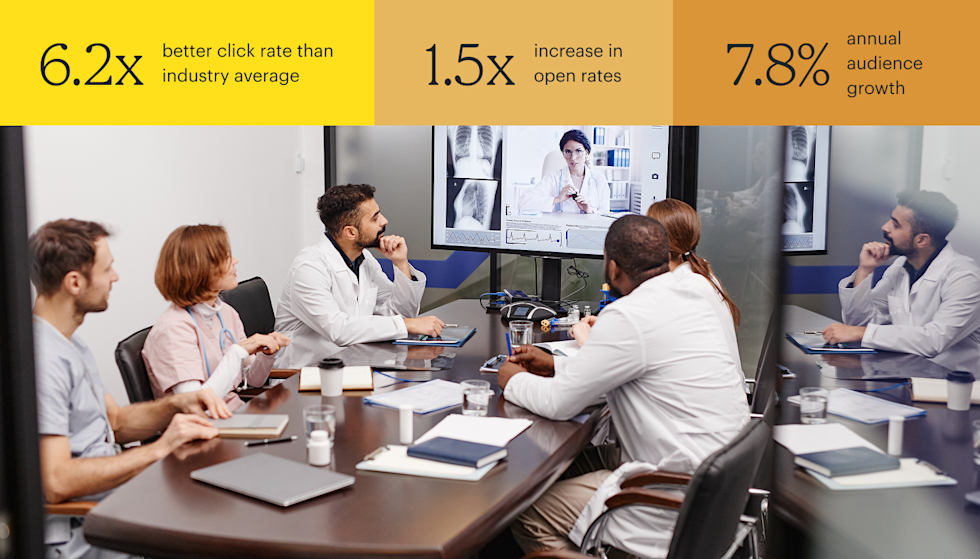
A group of medical professionals seated around a conference table participate in a video call with a colleague displayed on a screen showing X-rays. Stats on top are: 6.2x better click rate than industry average, 1.5x increase in open rates, and 7.8% annual audience growth.
Published: July 2026 – Public Broadcasting & Media – California, US – 1M+ subscribers
Every day, scientists around the world find their inboxes full of research papers, conference invitations, funding updates, and institutional announcements. Getting them to stop and actually read one of those messages (let alone engage with it) requires clearing a high bar.

Labroots knows this better than most. The California-based platform has spent 13 years connecting a global community of researchers, scholars, and science professionals with the latest discoveries across dozens of disciplines. Through scientific news, daily webinars, and large virtual events, Labroots gives scientists a place to hear directly from the researchers behind the work that moves their fields forward.

Rebecca Anaya, Labroots' Senior Marketing Manager, has been running experiments to figure out how to effectively reach that audience ever since she joined the team in 2021."I enjoy the science of it," Rebecca says. "You actually get something to compare as data. It's super useful."

With Intuit Mailchimp as her lab, Rebecca has helped Labroots move from sending emails with little intention behind them to communicating with precision. Now, their global audience of scientists stay engaged without feeling like they're being bombarded.

The challenge: Too many emails and not enough connection

Labroots runs webinars every single day, each with its own set of reminder emails. With a list of more than 429,000 contacts spanning research disciplines, institutions, and geographies, outgoing email volume adds up fast.

Scientists’ inboxes are already full of noise. Send too much, or send generic reminders, and Labroots risks becoming part of the problem.

"We’ve all become numb from the constant gratification we're getting from our apps, our phones," Rebecca says. "We have had to get a little more crafty with the way we formulate these emails, just to capture attention."

The team had instincts about what worked—short subject lines, clear calls to action, concise body copy. But instincts aren't data. Without a way to test assumptions at scale, they couldn’t know what was actually working or whether the whole approach needed to evolve.

“Mailchimp gives us the ability to scale and the confidence to test new ventures without the fear of speaking into a void. That's always number one when it comes to our marketing emails and working in Mailchimp.”

- Rebecca Anaya, Senior Marketing Manager, Labroots

The tools: A/B testing, marketing automation flows, and tags

Labroots started by focusing on the list itself. Working with their Mailchimp Customer Success Manager, the team began archiving unengaged contacts every 6 months, clearing out anyone who hadn't interacted with their emails in a meaningful stretch of time.

With a cleaner audience in place, Rebecca implemented A/B testing to find out what drove engagement. The team was already using what they believed to be best practices of keeping subject lines short and putting the call to action near the top, but testing gave them confirmation their instincts were right.

"We are finding that we are correct," Rebecca says. "But every now and then, you'll find a surprise. Maybe you think a certain subject line is going to be more impactful, and it ends up being the opposite. It's always exciting and fun."

Labroots saved time by building a marketing automation flow that eliminated manual email creation. Through a custom API integration, their production team can enter a webinar into Labroots' backend and watch a full sequence of reminder emails auto-generate in Mailchimp.

Segmentation and tags keep the right emails going to the right people. When scientists sign up for emails, they specify the research disciplines, institution types, and geographic regions they’re interested in. When those contacts are imported into Mailchimp, the team maps each one to the appropriate tags—when it's time to send, the list is already sorted.

The results: Growth at scale with engagement above industry average

The experimentation helped optimize their email strategy. Click rates on event-day reminder emails hit 20.8% (6.2 times the industry average). For Rebecca, that number means scientists who registered for a webinar are still engaged by the time the day arrives.

Open rates climbed to a peak of 55.3%, a 1.5x increase that puts Labroots well above the 37.15% industry benchmark. The strategy that once risked feeling like noise is now one of the better-performing communication programs in the space.

  • 6.2x

    better click rates than industry average

  • 1.5x

    increase in open rates

  • 7.8%

    annual audience growth

Labroots is using a multichannel acquisition strategy, and it’s working. By using signup forms across their website that automatically segment contacts by research interests, they added 31,008 net new subscribers over the past year. This pushed their events segment to more than 429,000 contacts—a 7.8% annual growth rate.

"Mailchimp gives us the ability to scale and the confidence to test new ventures without the fear of speaking into a void," Rebecca says. "That's always number one when it comes to our marketing emails and working in Mailchimp."

The next experiment is already in progress. Labroots is moving into podcasts, giving scientists another way to engage with the research and discoveries their community cares about. When it's ready to launch, they plan to run an email campaign and see what the data says.

Rebecca is also eyeing send-time optimization as the next variable to test. The data should tell her whether sending in the afternoon rather than the default morning Pacific Time could result in more opens from their North American audience.

For a team that treats email marketing like a discipline rather than a routine task, there's always another hypothesis to test.

"Mailchimp has allowed us to take our business to different levels," Rebecca says. "Whenever we have something new, we're going to run an email campaign. That's number one."

Your next best-performing email might be one test away.

Share This Article