How Segmentation Helped IMSE Triple Click‑Through Rates

After years of stagnant engagement, the literacy training organization nearly doubled its open rates with Mailchimp.

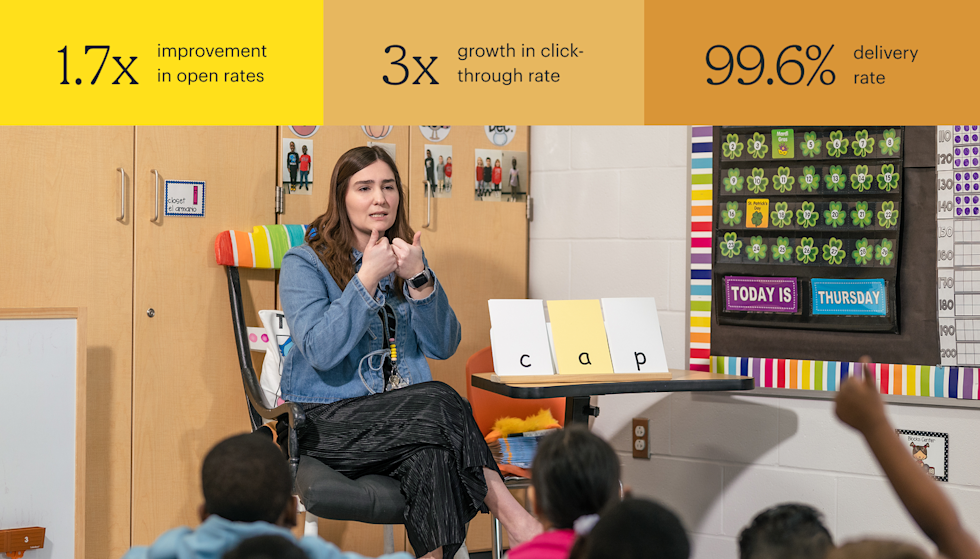
A teacher sits at the front of a classroom leading a phonics lesson with young students. She gestures with her hands while facing the class. On a small table beside her are letter cards spelling “cap.” Stats on top are: 1.7x improvement in open rates, 3x growth in click-through rate, and 99.6% delivery rate.
Published: April 2026 – Nonprofit – Michigan, US – 505,000+ subscribers

On the wall next to Sarah Hacker's desk hangs a drawing from one of her former students. In it, a child's handwriting spells out a message: “Thanks to Mrs. Hacker, I'm now able to read.”

It's the kind of thing that stays with a teacher. And it's part of why Sarah joined the Institute for Multi-Sensory Education (IMSE), a Michigan-based organization that has spent the past 30 years training educators in the science of how children learn to read.

Reading doesn't come naturally to every child. For many kids, the path to literacy runs through structured, multi-sensory instruction. IMSE exists to transform literacy research into action, empowering educators with knowledge, tools, and support to ensure every child learns to read.

Most of IMSE's team consists of former teachers, like Sarah who took IMSE’s training in 2020. "I told my best friend, I want to work for this company one day," Sarah says. "It completely changed my view on how to teach reading."

Sarah’s now a marketing assistant at IMSE, and is responsible for reaching an audience of more than half a million educators. The contact list she inherited with the job was large, but few recipients were listening.

With no formal marketing background, Sarah relied on a passion for IMSE’s mission and access to Intuit Mailchimp’s easy-to-learn platform to find success connecting with an audience.

The challenge: A half-million subscribers but almost no one listening

IMSE had built an email list of more than half a million contacts. The problem was that most of them weren't engaging.

Open rates plateaued between 20% and 25%, and the team was sending emails on autopilot, running campaigns without strategy. The emails were heavy on text and light on visuals, and went to the entire list regardless of whether a recipient was a general education teacher in Ohio or an administrator in Texas. 

There was limited segmentation or personalization, and most notably, nothing compelling to click. At one point, a batch of bot accounts had accidentally been imported into the list without anyone catching it. "It started to feel like we might be overwhelming or unintentionally spamming people," Sarah says.

And running point on it all was Sarah, who was learning as she went. Thankfully, she had a dedicated partner at Mailchimp to help guide her through it.

“I've never had any formal training in marketing," Sarah says, “Working with a dedicated Customer Success Manager, and using the tools that Mailchimp has really taught me a lot and made a huge difference."

*— Sarah Hacker, Marketing Assistant, IMSE*

The tools: Customer Success Manager, segmentation, and Canva integration

Removing the bots came first. Working with her Mailchimp Customer Success Manager, Sarah ran a reengagement campaign targeting contacts that hadn't interacted with IMSE in a specified period of time. Those who didn't respond got cut, including the bots.

"What good are these contacts sitting in your account if they're not interacting with you?" Sarah asks. "Why are you keeping them and paying for them, and continuing to shout into the void?"

With a cleaner audience in place, Sarah turned to segmentation to make sure the right content was reaching the right people. She began organizing contacts by IMSE course completion, job title, and location, while separating general education teachers from special education teachers and administrators. 

As IMSE launched new products for its 2 flagship curriculums, Sarah built dedicated marketing automation flows that recapped learnings  and linked to the full range of resources available to participants beyond the training itself.

One of IMSE's most popular recurring emails, a weekly "Freebie Friday" featuring a free teacher resource, became a reliable engagement touchpoint built into the automation cadence.

Personalization came via a feature Sarah calls her “secret sauce”: Mailchimp's first-name merge tag. Simple as it sounds, addressing each educator by name made a difference in how the emails landed. "My coworker messaged me and said, ‘I love that I saw my name in the email,’" Sarah says. "I think it's magical."

Without a graphic designer on the marketing team, Sarah leaned into Mailchimp's Canva integration to produce eye-catching emails. Designing in Canva and importing directly into Mailchimp allowed her to move quickly and keep the emails visually engaging. These were a meaningful upgrade from the prior text-heavy campaigns.

  • 1.7x

    Improvement in open rates

  • 3x

    Growth in click-through rates

  • 99.6%

    Delivery rates

The results: Exceeding the industry benchmark

After the earlier plateau in IMSE’s email open rates, their new campaigns climbed to a peak of 42.8%. This 1.7x lift put the organization well above the education industry benchmark of 35.64%. The improvement can be attributed to Sarah’s audience management and email structure changes. 

Click-through rates also saw dramatic improvements, jumping 3x to a peak of 6.9%. The shift from densely written, generic sends to visually appealing, personalized, segmented emails gave educators something to actually interact with.

Underpinning this success is a near-perfect 99.6% delivery rate across a list of 505,000 contacts. That number matters for an organization trying to change the lives of kids by teaching them to read and giving teachers the tools to make that happen.

“I've never had any formal training in marketing," Sarah says, “Working with a dedicated Customer Success Manager and using the tools that Mailchimp has really taught me a lot and made a huge difference."

As IMSE heads toward its 30th anniversary, Sarah is focused on expanding how the organization can target the educators who need its programs most. The next frontier is reaching district leaders who make budget decisions and persuading them to bring Structured Literacy training to entire schools at once.

This will mean pushing segmentation further and building out flows specifically designed for that audience.

For Sarah, the work has always been about something bigger than open and click-through rates. She wants to make sure teachers have what they need to reach every kid in their classroom, especially the ones who haven't yet found their way to reading.

"We're out here fighting the good fight for everyone to have access to Structured Literacy," Sarah says. "That's really why we do what we do."

Use segmentation to reach the right audience

Share This Article