How Team Player Productions captured more leads and automated outreach

The food and wine event producer replaced manual workflows with popup forms, SMS, and smarter segmentation—without adding headcount.

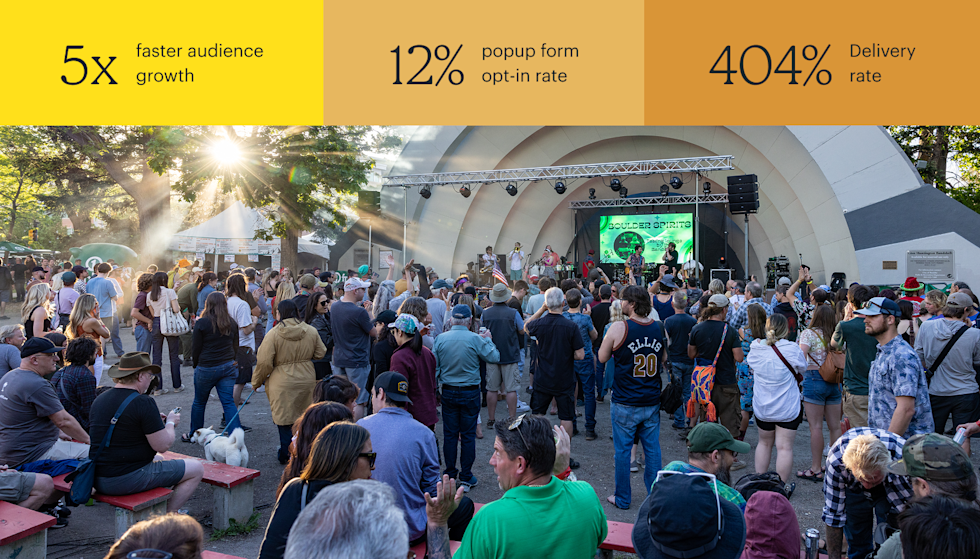
A crowd gathered outdoors watching a live band perform on a stage under a curved bandshell, with sunlight filtering through trees behind them. Stats on top are: 5x faster audience growth, 12% popup form opt-in rate, and 404% increase in net subscription growth.
Published: July 2026 – Entertainment & Leisure – Colorado, US – 211,000+ subscribers
Every summer weekend in Colorado, someone is opening a bottle of wine at a Team Player Productions event. The suburban Denver-based company crafts wine festivals, street fairs, and community leisure experiences that draw thousands of attendees from across the state.

Livvy Hampton, Team Player Productions’ (TPP) Marketing Manager, oversees the digital side of all of it: the email campaigns, the audience strategy, and the live event engagement tools that keep more than 211,000 fans connected to the company’s calendar year-round. It's a scope of work that would stretch a large operation, but her team only has 3 people.

TPP has a loyal audience, but it kept slipping through cracks. For a while, the tools they were working with hindered their small team more than they helped. Leads were captured through a static third-party form and manual ticket list exports. Contest registrations at live events were coordinated using the staff’s personal phones to text patrons. Between events, email sends were infrequent enough that deliverability was quietly degrading before the next ticket launch.

Even though TPP is a longtime Intuit Mailchimp user, they hadn’t connected their lead capture tools. But now, working with their Customer Success Manager (CSM), TPP has rebuilt their approach from the ground up with features that work together across their entire event portfolio.

"I just don't think we'd be able to scale and send the amount of emails that are targeted and specific in the way that we are able to with Mailchimp," Livvy says. "Especially being on such a lean team and managing 8- to 10-plus events."

The challenge: Growing fast with nothing running automatically

Audience is everything for an event company, and the disparate systems TPP was using to manage theirs weren’t keeping up with the pace of the business.

Ticket buyers were the most obvious gap. TPP's ticketing platform wasn't connected to Mailchimp, which meant every new batch of purchasers had to be exported, consent-verified, and uploaded by hand. Group tickets made it worse—only the lead buyer's information came through, leaving entire parties unaccounted for.

Between events, the problem compounded. Without a consistent sending cadence, TPP's deliverability was slowly decreasing in the background. This meant that when a ticket launch finally did arrive, they were working with a weaker foundation than they realized.

"We honestly weren't hitting our audience enough," Livvy says.

At live events, the limitations got even more personal—literally. Running contests at Oktoberfest meant coordinating signups, selecting winners, and notifying attendees in real time, all from the staff's personal phones while simultaneously managing the event.

“The way that Mailchimp took the time to meet with us numerous times to make sure that we knew what we were doing going into launching this campaign really made the difference for us. It gave us the confidence to be able to do that and to see success.”

- Livvy Hampton, Marketing Manager, Team Player Productions

The tools: Popup forms, SMS, and marketing automation flows

The first touchpoint TPP tackled was the moment a potential fan landed on their website. Rather than relying on a static signup form that was easy to scroll past, Livvy worked with her Mailchimp CSM to design a popup form built around a single question: What kind of wine drinker are you? The quiz format gave visitors a reason to engage, and completing it triggered an automated email with a significant ticket discount inside.

"It was kind of fun, because it was a little bit of a personality quiz for people," Livvy says. "By filling that out, which is just one question, they get sent a pretty big discount on tickets. So it worked in our favor where we learned a little bit more about them, and they got a discount as well." The popup became TPP's most popular promotion and handed Livvy audience intelligence she didn't have before.

That data fed directly into TPP's segmentation strategy. Using Mailchimp's tags, Livvy's team began organizing their audience by location, gender, ticket purchase history, and now wine persona. This provided the ability to craft messaging that spoke to specific segments rather than broadcasting the same story to everyone across 10 different event properties.

"We've been able to tell a different story than we were able to in the past," Livvy says, "and that's really worked well for us in terms of our email strategy and storytelling experience."

Marketing automation flows addressed the deliverability problem that had been building between events. Automated communications now go out on a consistent cadence, regardless of where TPP sits on the event calendar, keeping audiences engaged and maintaining the inbox presence that ticket launches depend on. Discounts offered after someone signed up for an event were automated as well.

"We've found that by automating our campaigns and sending more frequently, at least once a month, we've been able to improve our deliverability rate and see better results."

The most visible transformation, though, happened at Oktoberfest. TPP set up a QR code that routed attendees to a landing page that listed every active contest. Then, they used SMS to handle confirmation texts, automated winner selections, and instant notifications. This ensured that every entrant learned whether they’d won a prize, while keeping the staff’s personal contact information out of the equation.

With no dedicated designer on the team, Mailchimp's Canva integration meant Livvy could move from building an event asset to dropping it into a campaign in one motion.

"I can be editing in Canva one minute, and then flip over and quickly add that asset right into Mailchimp," she says. "It's really made the process of creating an email much more seamless."

The results: A lead generation engine built for scale

TPP’s efficiency gains using Mailchimp are striking. Compared to their previous approach of embedding forms manually, hand-managing exports, and individually verifying consent, TPP saw a significant increase in audience growth through lead capture efficiency. A process that once required ongoing manual intervention now runs 5 times faster on its own.

  • 5x

    faster audience growth

  • 12%

    popup form opt-in rate

  • 404%

    increase in net subscription growth

The one-question format and automated discount led to a meaningful percentage of site visitors becoming subscribers. After launching the wine personality quiz, TPP achieved a 12% opt-in rate across their event sites.

The investment in list health paid off, too. After running an off-season reengagement and audience cleanup campaign for their Breckenridge event, TPP's list came down to roughly half its previous size. When the ticket launch went live, opens and clicks exceeded the prior year's numbers. A smaller, cleaner audience outperformed a larger, unmanaged one. That discipline, combined with consistent sending, contributed to a 404% increase in net subscription growth across their audience.

The plan for TPP moving forward is to adapt the success they’ve had with the wine survey to street fairs and other events, extending the same targeted approach across every property they run.

"The way that Mailchimp took the time to meet with us numerous times—to make sure that we knew what we were doing going into launching this campaign really made the difference for us," Livvy says. "It gave us the confidence to be able to do that and to see success."

Ready to grow your audience, automatically?

Share This Article