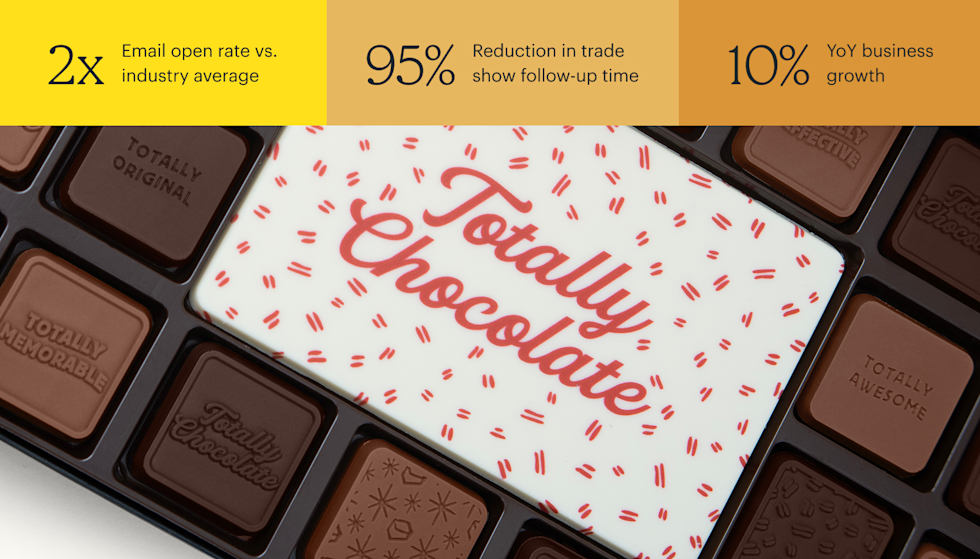
From dad jokes and two-pound chocolate bars, to cookies in exchange for social media follows, this chocolate manufacturer’s unconventional marketing is working.
Most of Totally Chocolate Promo’s history has been spent staying quiet in the background of the promotional products world, an industry known widely for company swag. They’ve been making premium custom chocolates for decades but had never actively marketed to the industry’s vast network of distributors. That changed when they hired Kristina Beal in April 2025 as Promotional Product Industry Lead to tap into a market that does $24 billion annually in sales.
Kristina came in and immediately reached for Intuit Mailchimp as her primary tool to execute a complete marketing overhaul. She used the platform to establish an email open rate twice the industry average while simultaneously managing the delicate balance of keeping 2 distinct business divisions—distributors and direct-to-consumer (D2C)—completely separate.
Totally Chocolate's monthly distributor newsletters blend education with personality, providing them resources they can use to grow their own businesses. Trade show follow-ups that once dragged on for days now happen in hours. But getting to this point required solving problems most suppliers never even consider—some that Kristina said could have destroyed the business if handled wrong.
The challenge: One mistake away from ruining relationships
Totally Chocolate's business model can create an unwanted situation that keeps her vigilant about audience management. The company operates 2 completely separate divisions: a D2C direct-to-business side that sells chocolate directly to end customers, and a promotional products side that works exclusively through distributors who represent Totally Chocolate to their own clients.
Mixing those audiences, even once, could harm business.
"Having separate CRMs is not just a good idea, it is a must," Kristina says. "It's mandatory for our business model. We don't ever want to steal business on our direct side from our distributors. They are our business partners, they are our sales force to open up places for our chocolate to go that we would never, on our own, have access to."
If a distributor partner sees a D2C price in an email meant for end buyers, the relationship could be over.
For example, when someone recently called saying they'd received Totally Chocolate as a Christmas gift from a distributor and wanted to order more for themselves, the response was: "We will reach out to your distributor and let them know how much you loved it, so you can place that order."
That trust is critical in the promotional products industry, which Kristina says is relationship-based, with some family businesses going back generations.
Totally Chocolate had no marketing infrastructure to support those relationships before Kristina arrived, and instead managing everything within Outlook. Email outreach happened manually and without cadence. There was no segmentation, no automation, no way to maintain consistent communication. When Kristina researched solutions, the integration costs to sync their HubSpot CRM data were too high.
Even if they solved the technical challenges, they faced a fundamental marketing problem: distributors are drowning in supplier emails. "A lot of suppliers in the industry inundate, and it becomes white noise, and you put it in your junk folder," Kristina says. "I wanted to disrupt the game there a little bit."
The challenge was particularly steep because food gifting represents only 1.3% of the promotional products industry's business. Distributors often cite risks about products going bad or melting as reasons they don't sell more food gifts. Kristina's goal was to change that perception by educating rather than selling.
"Stop selling and be a partner, especially business-to-business," Kristina says. "If you get rid of the whole mentality of 'my job is to sell you something,' and you're like, 'I'm gonna help you grow, we're gonna be partners in this business together,' I think it just changes everything."